Elasmobranquios (tiburones y rayas) (sharks and rays) >
Carcharhiniformes (Ground sharks) >
Triakidae (Houndsharks) > Triakinae
Etymology: Mustelus: Latin for weasel, an ancient name for sharks, possibly referring to the pointed snouts, swift movements and/or rapacious feeding behavior of smaller predatory sharks [strictly not tautonymous with Squalus mustelus Linnaeus 1758 since type was designated by the ICZN] (See ETYFish); andamanensis: -ensis, Latin suffix denoting place: Andaman Sea, Thailand, only known area of occurrence (See ETYFish).
Environment: milieu / climate zone / rango de profundidad / distribution range
Ecología
marino bentopelágico; rango de profundidad 50 - 100 m (Ref. 124465). Tropical
Eastern Indian Ocean: Andaman Sea: Myanmar and Thailand.
Tamaño / Peso / Age
Madurez: Lm ? range ? - ? cm
Max length : 104 cm TL macho / no sexado; (Ref. 124465); 108.5 cm TL (female)
Short description
Claves de identificación | Morfología | Morfometría
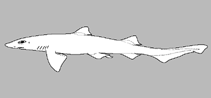
This species is distinguished by the following set of characters: palatine processes of palatoquadrates subdivided near the symphysis with a short, separate medial segment on each side; pre-second dorsal length 55.5-57.9% TL; upper labial furrows are shorter than lower ones, the uppers 0.7-1.1% TL and 0.6-0.9 times lowers; buccopharyngeal denticles cover most of the tongue and roof of mouth to about the third or fourth gill arch; no hypercalcification of skeletal elements, but no adult specimens examined; dorsal fins moderately large, upright with first dorsal-fin anterior margin 13.9-15.8% TL, height 9.2-10.1% TL; teeth in 69-80/64-73 files; precaudal vertebral centra 87-91, monospondylous centra 33-39; no small white spots on dorsal surface of body, including along lateral line; first dorsal fin without a white margin, the upper half dusky to blackish; second dorsal fin blackish distally; caudal fin with a narrow white margin and a distinct black tip on terminal caudal lobe (Ref. 124465).
Cross section: angular.
Specimens 37.6-71.7 cm TL were all found to be immature (Ref. 124465).
Life cycle and mating behavior
Madurez | Reproducción | Puesta | Huevos | Fecundidad | Larva
White, W.T., S. Arunrugstichai and G.J.P. Naylor, 2021. Revision of the genus Mustelus (Carcharhiniformes: Triakidae) in the northern Indian Ocean, with description of a new species and a discussion on the validity of M. walkeri and M. ravidus. Mar. Biodiversity 51(42):1-24. (Ref. 124465)
IUCN Red List Status (Ref. 130435: Version 2025-1)
Threat to humans
Harmless
Human uses
Herramientas
Special reports
Download XML
Fuentes de Internet
Estimates based on models
Phylogenetic diversity index (Referencia
82804): PD
50 = 0.5000 [Uniqueness, from 0.5 = low to 2.0 = high].
Bayesian length-weight: a=0.00224 (0.00104 - 0.00482), b=3.14 (2.97 - 3.31), in cm total length, based on LWR estimates for this Genus-body shape (Ref.
93245).
Nivel trófico (Referencia
69278): 3.6 ±0.4 se; based on size and trophs of closest relatives
Resiliencia (Referencia
120179): Medio, población duplicada en un tiempo mínimo de 1.4-4.4 años (Preliminary K or Fecundity.).
Fishing Vulnerability (Ref.
59153): High to very high vulnerability (65 of 100).
🛈