>
Perciformes/Serranoidei (Groupers) >
Serranidae (Sea basses: groupers and fairy basslets)
Etymology: Chelidoperca: Greek, chelidon, -onos = swift, as black as a swift + Greek, perke = perch (Ref. 45335); flavimacula: Name from Latin 'flavus' for yellow and 'macula' for spot; referring to the characteristic yellow spots covering the anal fin in this species.
Environment: milieu / climate zone / intervalo de profundidade / distribution range
Ecologia
marinhas associadas(os) a recifes; intervalo de profundidade 84 - 131 m (Ref. 123773). Tropical
Eastern Indian Ocean: Myanmar (Andaman Sea).
Tamanho / Peso / Idade
Maturidade: Lm ? range ? - ? cm
Max length : 7.1 cm SL macho/indeterminado; (Ref. 123773)
Descrição breve
Chaves de identificação | Morfologia | Morfometria
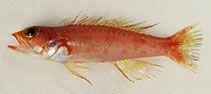
Espinhos dorsais (total) : 10; Raios dorsais moles (total) : 10; Espinhos anais: 3; Raios anais moles: 6. This species is distinguished from its congeners by the following set of characters: scale rows between the lateral line and middle of first dorsal-fin base 3 (2 full-sized plus 1 half-sized); pored lateral-line scales 42-45 (modally 42); pectoral-fin rays 15-16 (modally 15); predorsal scale rows 6; scale rows below the lateral line 9-10; circumpeduncular scales 16-17; no scale rows from ventral side of dentary; scale rows on interorbital area extending to mid-orbit level; maxilla is expanded posteriorly, covered ventrally by low skin fold; outermost row teeth of the upper jaw distinctly enlarged; gill rakers 6-7 + 10-12; developed gill rakers 1-2 + 6-8; serrations on preopercle 31-45; serrations on postemporal 2-5; body depth 4.1-4.3 in SL; head length 2.6-2.7 in SL; body with three, poorly-defined longitudinal rows of small whitish spots; dorsal fin transparent with about four longitudinal rows of bright yellow spots mostly covering the soft portion of fin; anal fin transparent white with yellow or reddish distal margin and three or four rows of bright yellow spots over its proximal half; posteriormost dorsal and anal-fin rays are with short alternating yellow and dark grey bands (Ref. 123773).
Cross section: compressed.
Life cycle and mating behavior
Maturidade | Reprodução | Desova | Ovos | Fecundidade | Larvas
Psomadakis, P.N., O. Gon and T. Htut, 2021. Two new species of the genus Chelidoperca (Perciformes: Serranidae) from the Andaman Sea, eastern Indian Ocean. Zootaxa 4927(1):87-103. (Ref. 123773)
Categoria na Lista Vermelha da IUCN (Ref. 130435: Version 2025-1)
Ameaça para o homem
Harmless
Utilização humana
Ferramentas
Relatórios especiais
Descarregue XML
Fontes da internet
Estimates based on models
Phylogenetic diversity index (Ref.
82804): PD
50 = 0.5000 [Uniqueness, from 0.5 = low to 2.0 = high].
Bayesian length-weight: a=0.01072 (0.00511 - 0.02246), b=3.06 (2.88 - 3.24), in cm total length, based on LWR estimates for this (Sub)family-body shape (Ref.
93245).
Nível Trófico (Ref.
69278): 3.5 ±0.5 se; based on size and trophs of closest relatives
Resiliência (Ref.
120179): Elevada, tempo mínimo de duplicação da população menor que 15 meses (Preliminary K or Fecundity.).
Fishing Vulnerability (Ref.
59153): Low vulnerability (10 of 100).
🛈