>
Gobiiformes (Gobies) >
Gobiidae (Gobies) > Gobiinae
Etymology: Callogobius: Greek, kalos, kallos = beautiful + Latin, gobius = gudgeon (Ref. 45335); falx: Name from Latin 'falx' for sickle, referring to the narrow bar on the caudal-fin base of the new species.
Environment: milieu / climate zone / rango de profundidad / distribution range
Ecología
marino demersal; rango de profundidad 12 - 22 m (Ref. 126574). Tropical
Western Pacific: Japan and the Philippines.
Tamaño / Peso / Age
Madurez: Lm ? range ? - ? cm
Max length : 2.3 cm SL macho / no sexado; (Ref. 126574)
Short description
Claves de identificación | Morfología | Morfometría
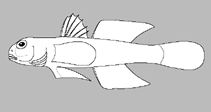
Espinas dorsales (total) : 7; Radios blandos dorsales (total) : 8 - 9; Espinas anales: 1; Radios blandos anales: 7. This species is distinguished by the following set of characters: D VI-I, 8-9; A I, 7; pectoral-fin rays 18-19; lateral scale rows 20-22; body depth is moderate, which is neither slender nor deep (depth at pelvic-fin origin 18.3-20.0% of SL); pelvic-fin base with frenum; caudal-fin length moderate, its margin rounded; no cephalic sensory-canal pores; interorbital papillae row (Row 3) may form two rows; postorbital papillae row (Row17) is not continuous with upper cranial papillae row (Row 18); preopercular and transverse opercular papillae rows (Rows 20 and 21, respectively) are connected, forming a single transverse row. Colouration: body with three oblique black bars, angled upwards anteriorly and continuous with black bars on dorsal fins, the anteriormost bar extending from first dorsal fin to midline of body, the two posterior bars extending from second dorsal fin to dorsal surface of body and caudal peduncle, respectively; pectoral fin white, with upper half widely (ca. 1/2 length of rays) margined with black; caudal-fin base with a narrow sickle-like bar (Ref. 126574).
Cross section: oval.
Life cycle and mating behavior
Madurez | Reproducción | Puesta | Huevos | Fecundidad | Larva
Fujiwara, K., T. Suzuki and H. Motomura, 2021. Callogobius falx, a new species of goby from southern Japan. Zootaxa 5048(2):253-264. (Ref. 126574)
IUCN Red List Status (Ref. 130435: Version 2025-1)
Threat to humans
Harmless
Human uses
Pesquerías: sin interés
Herramientas
Special reports
Download XML
Fuentes de Internet
Estimates based on models
Phylogenetic diversity index (Referencia
82804): PD
50 = 0.5000 [Uniqueness, from 0.5 = low to 2.0 = high].
Bayesian length-weight: a=0.01023 (0.00477 - 0.02194), b=3.01 (2.83 - 3.19), in cm total length, based on LWR estimates for this (Sub)family-body shape (Ref.
93245).
Nivel trófico (Referencia
69278): 3.1 ±0.3 se; based on size and trophs of closest relatives
Resiliencia (Referencia
120179): Alto, población duplicada en un tiempo mínimo inferior a 15 meses (Preliminary K or Fecundity.).
Fishing Vulnerability (Ref.
59153): Low vulnerability (10 of 100).
🛈