Classification / Names
Nomi Comuni | Sinonimi | Catalog of Fishes(Genere, Specie) | ITIS | CoL | WoRMS | Cloffa
>
Siluriformes (Catfishes) >
Loricariidae (Armored catfishes) > Hypostominae
Etymology: Cordylancistrus: Greek, kordyle, -es = young tunna + Greek, agkistron = hook (Ref. 45335); pijao: The name “pijao” refers to the native indigenous people, symbol of the Tolima department, who preferred to die rather than submit to Spanish monarchy; noon in apposition.
Environment: milieu / climate zone / distribuzione batimetrica / distribution range
Ecologia
; acqua dolce demersale. Tropical
South America: Colombia.
Size / Peso / Age
Maturità: Lm ? range ? - ? cm
Max length : 15.6 cm SL maschio/sesso non determinato; (Ref. 117343)
Short description
Chiavi di identificazione | Morfologia | Morfometria
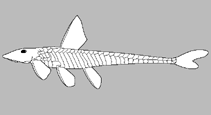
This species does not have a unique distinctive character for accurate identification, between its congeners it differs from Cordylancistrus torbesensis by an absence of plates on the ventral border of the snout (vs. ventral border of the snout covered with plates), and by the longest movable odontodes not reaching the pectoral-fin origin (vs. longest movable odontodes extending beyond the pectoral-fin origin); differs from C. platyrhynchus by having developed and evident evertibles cheek odontodes (vs. odontodes vestigial or almost imperceptible); differs from C. daguae by having the adpressed dorsal fin not reaching adipose-fin origin (vs. adpressed dorsal fin reaching adipose-fin origin), and by having a greater postdorsal length (26.8%-31.2% SL vs. 34.6%-39.8% SL); differs from C. nephelion and C. perijae by having a different color pattern: C. pijao has the dorsal and lateral sections of head and body light brown or beige with rounded or elongated dark (black) blotches, sometimes faded or barely visible, without a definite pattern while C. nephelion has the dorsal and lateral sections of the head and body blackish to greenish brown with numerous white irregular spots and C. perijae has the dorsal surface of head and body uniformly brown; differs Andeancistrus platycephalus by the absence of spiny keels on the lateral plates of the body (vs. lateral plates with spiny keels); diffes from A. eschwartzae by the snout covered with bony plates, except at the tip (vs. snout completely covered with plates), by a longer posterior body region, narrower body, and shorter dentary (postdorsal length 34.6%-39.8% SL vs. 31.3%-34.9% SL; cleithral width 30.3%-37.7% SL vs. 37.4%-40.8% SL, dentary length 8.4%-10.2% SL vs. 11.6%-12.8% SL); differs from Transancistrus santarosensis
and T. aequinoctiale by the snout covered with bony plates, except at the tip (vs. lateral edges and partial dorsal region of the snout naked) (Ref. 117343).
Cross section: flattened.
Occurs in quebrada Aguas Blancas which has a gravel and sand bottom, and in the area of its mouth in the Cuide Blanco River, mainly with moderate-sized rocks that allow the formation of small backwaters; average temperature is 18° C, with a slightly basic pH (8.1) and moderate conductivity (192.8 µS). The area is characterized by the presence grazing zones and small coffee farms. The original forests have been felled, and zones at different stages of secondary succession are found. At the stream’s mouth, are some large trees (common name caracolí) and some shrubs (Ref. 117343).
Life cycle and mating behavior
Maturità | Riproduzione | Deposizione | Uova | Fecundity | Larve
Provenzano, F.R. and F.A. Villa-Navarro, 2017. A new species of the catfish genus Cordylancistrus (Siluriformes, Loricariidae) from the Magdalena River, Tolima, Colombia. Zootaxa 4294(5):522-530. (Ref. 117343)
IUCN Red List Status (Ref. 130435: Version 2025-1)
Threat to humans
Harmless
Human uses
Strumenti
Special reports
Download XML
Fonti Internet
Estimates based on models
Phylogenetic diversity index (Fonte Biblio.
82804): PD
50 = 0.5156 [Uniqueness, from 0.5 = low to 2.0 = high].
Bayesian length-weight: a=0.01549 (0.00719 - 0.03336), b=2.98 (2.81 - 3.15), in cm total length, based on LWR estimates for this (Sub)family-body shape (Ref.
93245).
Resilienza (Fonte Biblio.
120179): Medio, tempo minimo di raddoppiamento della popolazione 1.4 - 4.4 anni (Preliminary K or Fecundity.).
Fishing Vulnerability (Ref.
59153): Low vulnerability (10 of 100).
🛈