



Upload your photos and videos
Google image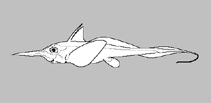 No image available for this species;
drawing shows typical species in Rhinochimaeridae.
Google image
drawing shows typical species in Rhinochimaeridae.
Classification / Names Common names | Synonyms | Catalog of Fishes(genus, species) | ITIS | CoL | WoRMS | Cloffa
Holocephali (chimaeras) > Chimaeriformes (Chimaeras) > Rhinochimaeridae (Longnose chimaeras)
Etymology: Harriotta: [an]a- (L.), belonging to: per Goode & Bean (1896), in honor of Thomas Harriott (ca. 1560‒1621), English astronomer, mathematician, ethnographer and translator, who published the first English work on American natural history (1588) (See ETYFish); avia: Name from Latin noun 'avia' for grandmother, in memory of June Thomas who proudly supported her granddaughter’s (BF) science career.
Eponymy: Thomas Harriott (ca: 1560–1621) was an English astronomer, mathematician, ethnographer and translator, who published first English work on American natural history (1588). [...] (Ref. 128868), visit book page.
Etymology: Harriotta: [an]a- (L.), belonging to: per Goode & Bean (1896), in honor of Thomas Harriott (ca. 1560‒1621), English astronomer, mathematician, ethnographer and translator, who published the first English work on American natural history (1588) (See ETYFish); avia: Name from Latin noun 'avia' for grandmother, in memory of June Thomas who proudly supported her granddaughter’s (BF) science career.
Eponymy: Thomas Harriott (ca: 1560–1621) was an English astronomer, mathematician, ethnographer and translator, who published first English work on American natural history (1588). [...] (Ref. 128868), visit book page.
Environment: milieu / climate zone / depth range / distribution range Ecology
Marine; bathydemersal; depth range 260 - 1278 m (Ref. 132499), usually 400 - 1000 m (Ref. 132499). Tropical
Distribution Territories | FAO areas | Ecosystems | Occurrences | Point map | Introductions | Faunafri
Southwest Pacific: New Zealand-Australia region.
Size / Weight / Age
Maturity: Lm ? range ? - ? cm
Max length : 33.4 cm TL male/unsexed; (Ref. 132499); 44.5 cm TL (female)
Max length : 33.4 cm TL male/unsexed; (Ref. 132499); 44.5 cm TL (female)
Short description Identification keys | Morphology | Morphometrics
This species is distinguished from its congeners by the following set of characters: snout elongated, narrow and depressed up to 56% BDL; trunk long, slender; vomerine tooth plate beak-like; eye largelength 8-12% BDL and height 5-7% BDL; long dorsal spine reaching slightly beyond apex of the dorsal fin; pelvic claspers slender rod-likel; deciduous skin; uniform chocolate brown when skin intact (Ref. 132499).
Cross section: oval.
Cross section: oval.
Widespread on the continental slope and over seamounts and ridges. In terms of length measurements of specimens examined: largest female 44.5 cm BDL (107.5 cm TL), male 33.4 cm BDL (95.7 cm TL); smallest mature male 30.0 cm BDL (79.1 cm TL), largest adolescent male 24.9 cm BDL (67.2 cm TL); smallest mature female 36.2 cm BDL (85.9 cm TL), largest adolescent female 36.6 cm BDL (95.1 cm TL). Maturity was estimated at 28.6 cm BDL for males and 37.2 cm BDL for females (Ref. 132499).
Life cycle and mating behavior Maturity | Reproduction | Spawning | Eggs | Fecundity | Larvae
Main reference
Upload your references | References | Coordinator | Collaborators
Finucci, B., D. Didier, D.A. Ebert, M.E. Green and J.M. Kemper, 2024. Harriotta avia sp. nov., a new rhinochimaerid (Chimaeriformes: Rhinochimaeridae) described from the Southwest Pacific. Environ Biol Fish (2024)107:841-865. (Ref. 132499)
IUCN Red List Status (Ref. 130435: Version 2025-2 (Global))
Least Concern (LC) ; Date assessed: 25 August 2024
CITES
Not Evaluated
Threat to humans
Harmless
Human uses
FAO - Publication: search | FishSource |
More information
Trophic ecology
Food items (preys)
Diet composition
Food consumption
Food rations
Predators
Food items (preys)
Diet composition
Food consumption
Food rations
Predators
Ecology
Ecology
Ecology
Population dynamics
Growth parameters
Max. ages / sizes
Length-weight rel.
Length-length rel.
Length-frequencies
Mass conversion
Recruitment
Abundance
Growth parameters
Max. ages / sizes
Length-weight rel.
Length-length rel.
Length-frequencies
Mass conversion
Recruitment
Abundance
Life cycle
Reproduction
Maturity
Maturity/Gills rel.
Fecundity
Spawning
Spawning aggregations
Eggs
Egg development
Larvae
Larval dynamics
Reproduction
Maturity
Maturity/Gills rel.
Fecundity
Spawning
Spawning aggregations
Eggs
Egg development
Larvae
Larval dynamics
Anatomy
Gill area
Brain
Otolith
Gill area
Brain
Otolith
Physiology
Body composition
Nutrients
Oxygen consumption
Swimming type
Swimming speed
Visual pigments
Fish sound
Diseases & Parasites
Toxicity (LC50s)
Body composition
Nutrients
Oxygen consumption
Swimming type
Swimming speed
Visual pigments
Fish sound
Diseases & Parasites
Toxicity (LC50s)
Genetics
Genome
Genetics
Heterozygosity
Heritability
Genetic Diversity
Genome
Genetics
Heterozygosity
Heritability
Genetic Diversity
Human related
Aquaculture systems
Aquaculture profiles
Strains
Ciguatera cases
Stamps, coins, misc.
Aquaculture systems
Aquaculture profiles
Strains
Ciguatera cases
Stamps, coins, misc.
Tools
Special reports
Download XML
Internet sources
AFORO (otoliths) | Aquatic Commons | BHL | Cloffa | Websites from users | Check FishWatcher | CISTI | Catalog of Fishes: genus, species | DiscoverLife | ECOTOX | FAO - Publication: search | Faunafri | Fishipedia | Fishtrace | GloBI | Google Books | Google Scholar | Google | IGFA World Record | OneZoom | Open Tree of Life | Otolith Atlas of Taiwan Fishes | PubMed | Reef Life Survey | Socotra Atlas | TreeBase | Tree of Life | Wikipedia: Go, Search | World Records Freshwater Fishing | Zoobank | Zoological Record
Estimates based on models
Phylogenetic diversity index (Ref. 82804): PD50 = 0.6270 [Uniqueness, from 0.5 = low to 2.0 = high].
Bayesian length-weight: a=0.00195 (0.00083 - 0.00455), b=3.14 (2.94 - 3.34), in cm total length, based on LWR estimates for this (Sub)family-body shape (Ref. 93245).
Trophic level (Ref. 69278): 3.6 ±0.4 se; based on size and trophs of closest relatives