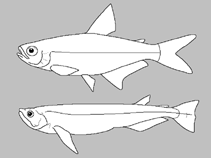
Classificatie / Namen
Lokale namen | Synoniemen | Catalog of Fishes(Genus, Soort(en)) | ITIS | CoL | WoRMS | Cloffa
>
Characiformes (Characins) >
Characidae (Characins; tetras) > Characinae
Etymology: Phenacogaster: Greek, phenax, -akos = deceptive + Greek, gaster = stomach (Ref. 45335); guayupe: Named after the Guayupe people with whom it shares its past geographical distribution: inhabitants of the Ariari River until the Spanish invasion, the Guayupe people were considered one of the most developed tribes in this region and this recognizes the important cultural and archaeological heritage that the Guayupes left to the Colombian Orinoco.
Environment: milieu / Klimaatzone / Diepte / distribution range
Ecologie
; zoet water benthopelagisch. Tropical
South America: Colombia.
Grootte / Gewicht / Leeftijd
Maturiteit: Lm ? range ? - ? cm
Max length : 3.8 cm SL mannelijk / geslacht onbekend; (Ref. 132565)
Korte beschrijving
Determinatiesleutels | Morfologie | Morfometrie
Dorsale zachte stralen (totaal) : 8 - 9; Anale zachte stralen: 31 - 34; Wervels: 36. This species is distinguished from its congeners, except P. capitulata, P. carteri, P. lucenae, P. napoatilis, P. nukak, P. tegatus, P. yari, by the incomplete lateral line; differs from P. nukak, P. tegatus, P. yari by having humeral spot in females near the pseudotympanum from the second to the fifth rib from the end of pseudotympanum (vs. a humeral spot present in males and females, away from the pseudotympanum, and reaching the vertical that passes through the first dorsal-fin ray); differs from P. carteri by the humeral spot in females (vs. humeral spot absent in both sexes); differs from P. capitulata, P. napoatilis by presence of humeral spot relatively large and round in females with width greater than half the ocular diameter (vs. an oblique and narrow humeral spot with width less than half the ocular diameter), fewer teeth in the maxilla 18-22 (n ¼ 9) (vs. 22-28 in P. capitulata and 20-29 in P. napoatilis, and it differs from the latter due to the bony hooks in the anal fin, these found in the first to maximum twenty-first branched ray, larger in size after the eleventh (vs. from first to nineteenth branched ray, all rays with the same size) (Ref. 132565).
Cross section: compressed.
Levenscyclus en paargedrag
Maturiteit | Voortplanting | Paaien | Eieren | Fecunditeit | Larven
Romero-Figueroa, A. and T.P. Carvalho, 2024. Four new species of Phenacogaster (Characiformes: Characidae) and a review of its diversity in Colombia. Ichthyol. Herpetol. 112(4):619-644. (Ref. 132565)
Status op de Rode Lijst van het IUCN (Ref. 130435: Version 2025-1)
Gevaar voor de mens
Harmless
Gebruik door de mens
Visserij: van geen belang
Tools
Speciale rapporten
Download XML
Internetbronnen
Estimates based on models
Fylogenetische diversiteitsindex (Ref.
82804): PD
50 = 0.5000 [Uniqueness, from 0.5 = low to 2.0 = high].
Trofisch niveau (Ref.
69278): 3.3 ±0.5 se; based on size and trophs of closest relatives
Fishing Vulnerability (Ref.
59153): Low vulnerability (10 of 100).
🛈