Classification / Names
Common names | Synonyms | Catalog of Fishes(genus, species) | ITIS | CoL | WoRMS | Cloffa
Teleostei (teleosts) >
Cypriniformes (Carps) >
Nemacheilidae (Brook loaches)
Etymology: kottelati: Named for MauriceKottelat, for his contributions advanced significantly the understanding of the world’s fish fauna.
Environment: milieu / climate zone / depth range / distribution range
Ecology
Freshwater; demersal. Subtropical
Distribution
Countries | FAO areas | Ecosystems | Occurrences | Point map | Introductions | Faunafri
Europe: Turkey.
Size / Weight / Age
Maturity: Lm ? range ? - ? cm
Max length : 5.0 cm SL male/unsexed; (Ref. 132448)
Short description
Identification keys | Morphology | Morphometrics
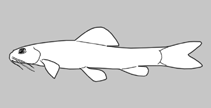
This species is distinguished from other species in the Aegean and adjacent basins by the following set of characters: body with a marbled pattern (vs. more or less irregularly shaped dark brown or pale brown blocks or bars on the flank in O. germencicus, O. theophilii, O. eliasi, O. simavicus, O. fatmae, O. angorae); with a deeper caudal peduncle, its depth 1.0-1.3 in its length (vs. 1.3-2.2, except O. theophilii); wider interorbital distance, 28-36% HL (vs. 20-28, except O. germencicus, O. angorae); differs from O. marmaraensis by the presence of an axillary lobe at the base of the pelvic fin (vs. absent) and has a narrower median incision in the upper lip (Ref. 132448).
Cross section: oval.
Life cycle and mating behavior
Maturity | Reproduction | Spawning | Eggs | Fecundity | Larvae
Turan, D., S. Aksu, S.S. Guclu and G. Kalayci, 2024. Oxynoemacheilus kottelati, a new species from the Havran and Karinca streams in Northern Aegean Basin, Turkiye (Teleostei, Nemacheilidae). Zoosyst. Evol. 100 (2) 2024, 483-492. (Ref. 132448)
IUCN Red List Status (Ref. 130435: Version 2025-1)
Threat to humans
Harmless
Human uses
Tools
Special reports
Download XML
Internet sources
Estimates based on models
Phylogenetic diversity index (Ref.
82804): PD
50 = 0.5000 [Uniqueness, from 0.5 = low to 2.0 = high].
Trophic level (Ref.
69278): 2.8 ±0.3 se; based on size and trophs of closest relatives
Resilience (Ref.
120179): High, minimum population doubling time less than 15 months (Preliminary K or Fecundity.).
Fishing Vulnerability (Ref.
59153): Low vulnerability (10 of 100).
🛈