Classification / Names
Common names | Synonyms | Catalog of Fishes(genus, species) | ITIS | CoL | WoRMS | Cloffa
Teleostei (teleosts) >
Siluriformes (Catfishes) >
Loricariidae (Armored catfishes) > Hypostominae
Etymology: Panaqolus: Derived from Panaque, see; orcesi: Name 'orcesi' in honor of Gustavo Orces, for his extensive contributions to the knowledge vertebrate biodiversity in Ecuador.
Environment: milieu / climate zone / depth range / distribution range
Ecology
Freshwater; benthopelagic; depth range ? - 1 m (Ref. 131037). Tropical
South America: Ecuador.
Size / Weight / Age
Maturity: Lm ? range ? - ? cm
Max length : 18.1 cm SL male/unsexed; (Ref. 131037)
Short description
Identification keys | Morphology | Morphometrics
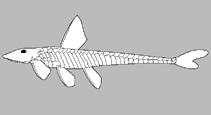
Dorsal spines (total): 1; Dorsal soft rays (total): 7; Anal soft rays: 4. This species is distinguished from its congeners by the following set of characters: base color of head, body, and fins uniformly grey, brown, or black, with light (cream, yellow or gold) dots; dentary teeth 5-7; distal tips of the dentaries converging to form an acute angle; inter-dorsal distance 12.1-12.7% SL; abdominal length 23.0-25.3% SL; dorsal-fin base length 33.1-35.0% SL; dorsal- and pectoral-fin spines 34.0-34.1% SL, 35.8-37.4% SL; caudal peduncle 11.8-12.7% SL; snout length 68.5; orbital diameter 17.1-18.3% HL; maximum standard length 180.6 mm; interorbital distance 44.5-45.8% HL; snout length 68.5-70.3% HL; inter-dorsal distance 12.1-12.7% SL; dorsal-fin spine 34.0-34.1% SL; smaller average mid lateral dot sizes for a given size individual; higher average number of dots on dorsal surface of pectoral fin (Ref. 131037).
Cross section: oval.
Life cycle and mating behavior
Maturity | Reproduction | Spawning | Eggs | Fecundity | Larvae
Provenzano-Rizzi, F., R. Barriga-Salazar and D.J. Stewart, 2024. Two new species of the armored catfish genus Panaqolus (Siluriformes, Loricariidae) from the Ecuadorian Amazon. Zootaxa 5463(1):112-126. (Ref. 131037)
IUCN Red List Status (Ref. 130435: Version 2025-1)
Threat to humans
Harmless
Human uses
Fisheries: of no interest
Tools
Special reports
Download XML
Internet sources
Estimates based on models
Phylogenetic diversity index (Ref.
82804): PD
50 = 0.5002 [Uniqueness, from 0.5 = low to 2.0 = high].
Resilience (Ref.
120179): Medium, minimum population doubling time 1.4 - 4.4 years (Preliminary K or Fecundity.).
Fishing Vulnerability (Ref.
59153): Low vulnerability (12 of 100).
🛈