Classificação / Names
Nomes comuns | Sinónimos | Catalog of Fishes(Género, Espécies) | ITIS | CoL | WoRMS | Cloffa
>
Siluriformes (Catfishes) >
Loricariidae (Armored catfishes) > Hypostominae
Etymology: Pseudacanthicus: Greek, pseudes = false + Greek, akantha = thorn (Ref. 45335); nyktos: Name 'nyktos' from the Greek word night in reference to the dark color of the specimen.
Environment: milieu / climate zone / intervalo de profundidade / distribution range
Ecologia
; Água doce demersal. Tropical
South America: Brazil.
Tamanho / Peso / Idade
Maturidade: Lm ? range ? - ? cm
Descrição breve
Chaves de identificação | Morfologia | Morfometria
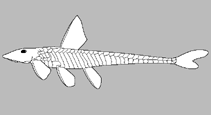
Raios dorsais moles (total) : 8; Raios anais moles: 5. This species is distinguished from its congeners by the following set of characters: dark brown to black body with light gray vermicular spots on the dorsal and ventral surfaces, and fins; lower mode number of teeth in premaxilla and dentary: 3 and 5, respectively; crown shaped anterior edge of supraoccipital with three tips, one larger central tip and two smaller lateral tips; thin and elongated nasal shape; absence of rectangular lateral ethmoid with lateral projection; anterior process of metapterygoid short and straight (Ref. 133457).
Body shape (shape guide): elongated; Cross section: flattened.
This species is found up to 20 meters deep in the main channel of rivers, commonly sheltering near submerged logs. In captivity, it exhibits a carnivorous diet, feeding mainly on small aquatic invertebrates. The species is notably territorial, often displaying intraspecific agression towards sympatric populations. During the reproductive period, males play an active role by confining females in burrows until egg-laying is complete (Ref. 133457).
Life cycle and mating behavior
Maturidade | Reprodução | Desova | Ovos | Fecundidade | Larvas
Lopes, M.L.B.G., L.M.D. Sousa and C.C. Chamon, 2024. New species of Pseudacanthicus (Siluriformes: Loricariidae) from the rio
Xingu, Amazon, Brazil. Neotropical Ichthyology 22(3):e240033. (Ref. 133457)
Categoria na Lista Vermelha da IUCN (Ref. 130435: Version 2025-1)
Ameaça para o homem
Harmless
Utilização humana
Pescarias: sem interesse
Ferramentas
Relatórios especiais
Descarregue XML
Fontes da internet
Estimates based on models
Phylogenetic diversity index (Ref.
82804): PD
50 = 0.5039 [Uniqueness, from 0.5 = low to 2.0 = high].
Resiliência (Ref.
120179): Baixo, tempo mínimo de duplicação da população 4,5 - 14 anos (Preliminary K or Fecundity.).
Fishing Vulnerability (Ref.
59153): Low to moderate vulnerability (29 of 100).
🛈