Classification / Names
Common names | Synonyms | Catalog of Fishes(genus, species) | ITIS | CoL | WoRMS | Cloffa
Teleostei (teleosts) >
Gobiiformes (Gobies) >
Butidae (Gudgeon gobies)
Etymology: Ophiocara: Greek, ophis = serpent + Greek, kara = face (Ref. 45335); gigas: Name 'gigas' refers to the adult maximum size in this species, being greater than those of congeners.
Environment: milieu / climate zone / depth range / distribution range
Ecology
Marine; freshwater; brackish; demersal; amphidromous (Ref. 133165). Subtropical
Distribution
Countries | FAO areas | Ecosystems | Occurrences | Point map | Introductions | Faunafri
Indo-Pacific: Japan (Ryukyu Archipelago), the Philippines, Palau, Micronesia, Indonesia, the Solomon Islands, Fiji, Vanuatu, and New Caledonia; including Papua New Guinea (New Ireland).
Size / Weight / Age
Maturity: Lm ? range ? - ? cm
Max length : 13.7 cm SL male/unsexed; (Ref. 133165); 13.5 cm SL (female)
Short description
Identification keys | Morphology | Morphometrics
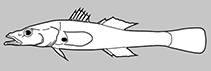
Dorsal spines (total): 7; Dorsal soft rays (total): 7; Anal spines: 1; Anal soft rays: 7 - 8; Vertebrae: 25 - 26. This species is distinguished from its congeners by the following set of characters: longitudinal row scales 32-36; predorsal scales 21-26; snout length 10.3-12.0% of SL; upper jaw length 13.6-16.2% of SL; pectoral fin length in young specimens (< 97.7 mm SL) 25.0-27.6% of SL; caudal fin length 28.3-36.7% of SL; opercular scales cycloid; infraorbital neuromast rows from the eye are usually seven. Colouration: trunk with two beige oblique bands; dorsal and caudal fins with dark brown spots; juveniles with white or light brown markings on middle and ventral parts of caudal fin base (Ref. 133165).
Body shape (shape guide): fusiform / normal; Cross section: oval.
Life cycle and mating behavior
Maturity | Reproduction | Spawning | Eggs | Fecundity | Larvae
Kobayashi, H. and M. Sato, 2023. The genus Ophiocara (Teleostei: Butidae) in Japan, with descriptions of two new species. Ichthyol. Res. 71(1):119-153. (Ref. 133165)
IUCN Red List Status (Ref. 130435: Version 2025-1)
Threat to humans
Harmless
Human uses
Fisheries: of no interest
Tools
Special reports
Download XML
Internet sources
Estimates based on models
Phylogenetic diversity index (Ref.
82804): PD
50 = 0.5312 [Uniqueness, from 0.5 = low to 2.0 = high].
Trophic level (Ref.
69278): 3.8 ±0.6 se; based on size and trophs of closest relatives
Resilience (Ref.
120179): High, minimum population doubling time less than 15 months (Preliminary K or Fecundity.).
Fishing Vulnerability (Ref.
59153): Low vulnerability (10 of 100).
🛈