-

- About this page
- Languages
- User feedbacks
- Citation
- Uploads
- Related species
-



Apristurus iterum White, O’Neill & Jayasinghe, 2025
Copy catshark
Upload your photos and videos
Google image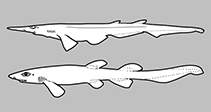 No image available for this species;
drawing shows typical species in Pentanchidae.
Google image
drawing shows typical species in Pentanchidae.
Classification / Names Common names | Synonyms | Catalog of Fishes(genus, species) | ITIS | CoL | WoRMS | Cloffa
Elasmobranchii (sharks and rays) > Carcharhiniformes (Ground sharks) > Pentanchidae (Deepwater catsharks)
Etymology: Apristurus: a-, Latin privative, i.e., without; pristis, from pristes (Gr.), sawyer (but here meaning saw); oura (Gr.), tail, referring to absence of saw-toothed crest of enlarged dermal denticles along upper edge of caudal fin as found in the closely related Pristiurus (=Galeus) (See ETYFish); iterum: Name 'iterum' from the Latin adverb meaning 'again, a second time, or once more', in allusion to the discovery of a new species of Apristurus.
Etymology: Apristurus: a-, Latin privative, i.e., without; pristis, from pristes (Gr.), sawyer (but here meaning saw); oura (Gr.), tail, referring to absence of saw-toothed crest of enlarged dermal denticles along upper edge of caudal fin as found in the closely related Pristiurus (=Galeus) (See ETYFish); iterum: Name 'iterum' from the Latin adverb meaning 'again, a second time, or once more', in allusion to the discovery of a new species of Apristurus.
Environment: milieu / climate zone / depth range / distribution range Ecology
Marine; bathydemersal; depth range 540 - 560 m (Ref. 138162). Subtropical
Distribution Territories | FAO areas | Ecosystems | Occurrences | Point map | Introductions | Faunafri
Western Central Pacific: Australia.
Size / Weight / Age
Maturity: Lm ? range ? - ? cm
Max length : 53.7 cm TL (female)
Max length : 53.7 cm TL (female)
Short description Identification keys | Morphology | Morphometrics
This species is distinguished from its congeners by the following set of characters: head moderately long and broad, head length 22.4% TL, interorbital space 7.0% TL; snout moderately long, pre-oral length 9.3% TL, preorbital length 9.5% TL; mouth very wide, its width 10.7% TL; pelvic-anal space 3.4% TL; anal fin large, base length 17.7% TL, posterior margin 12.5% TL; prepectoral length relatively long, 21.9% TL; labial furrows long, not confined to mouth corners, uppers longer than lowers (3.9 vs. 2.3% TL); enlarged denticles absent on upper or lower caudal fin; 35 monospondylous centra; 35 precaudal-diplospondylous vertebrae; precaudal centra 70; females mature by 537 mm TL; and egg case small (49.4-67.6 mm long), with 10-14 weakly T-shaped ridges on dorsal and ventral surfaces (Ref. 138162)
Body shape (shape guide): elongated.
Body shape (shape guide): elongated.
Facultative air-breathing
Life cycle and mating behavior Maturity | Reproduction | Spawning | Eggs | Fecundity | Larvae
Main reference
Upload your references | References | Coordinator | Collaborators
White, W.T., H.L. O'Neill and S.A. Jayasinghe, 2025. Apristurus iterum, a new shark discovered based on egg case morphology and sequence data obtained from a formalin-fixed specimen. J Fish Biol. 1-17. (Ref. 138162)
CITES
Not Evaluated
Threat to humans
Harmless
Human uses
Fisheries: of no interest
FAO - Publication: search | FishSource |
More information
Trophic ecology
Food items (preys)
Diet composition
Food consumption
Food rations
Predators
Food items (preys)
Diet composition
Food consumption
Food rations
Predators
Ecology
Ecology
Ecology
Population dynamics
Growth parameters
Max. ages / sizes
Length-weight rel.
Length-length rel.
Length-frequencies
Mass conversion
Recruitment
Abundance
Growth parameters
Max. ages / sizes
Length-weight rel.
Length-length rel.
Length-frequencies
Mass conversion
Recruitment
Abundance
Life cycle
Reproduction
Maturity
Maturity/Gills rel.
Fecundity
Spawning
Spawning aggregations
Eggs
Egg development
Larvae
Larval dynamics
Reproduction
Maturity
Maturity/Gills rel.
Fecundity
Spawning
Spawning aggregations
Eggs
Egg development
Larvae
Larval dynamics
Anatomy
Gill area
Brain
Otolith
Gill area
Brain
Otolith
Physiology
Body composition
Nutrients
Oxygen consumption
Swimming type
Swimming speed
Visual pigments
Fish sound
Diseases & Parasites
Toxicity (LC50s)
Body composition
Nutrients
Oxygen consumption
Swimming type
Swimming speed
Visual pigments
Fish sound
Diseases & Parasites
Toxicity (LC50s)
Genetics
Genome
Genetics
Heterozygosity
Heritability
Genetic Diversity
Genome
Genetics
Heterozygosity
Heritability
Genetic Diversity
Human related
Aquaculture systems
Aquaculture profiles
Strains
Ciguatera cases
Stamps, coins, misc.
Aquaculture systems
Aquaculture profiles
Strains
Ciguatera cases
Stamps, coins, misc.
Tools
Special reports
Download XML
Internet sources
AFORO (otoliths) | Aquatic Commons | BHL | Cloffa | Websites from users | Check FishWatcher | CISTI | Catalog of Fishes: genus, species | DiscoverLife | ECOTOX | FAO - Publication: search | Faunafri | Fishipedia | Fishtrace | GloBI | Google Books | Google Scholar | Google | IGFA World Record | OneZoom | Open Tree of Life | Otolith Atlas of Taiwan Fishes | PubMed | Reef Life Survey | Socotra Atlas | TreeBase | Tree of Life | Wikipedia: Go, Search |