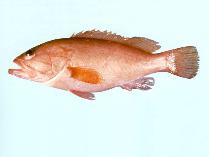
Environment: milieu / climate zone / Tiefenbereich / distribution range
Ökologie
seewasser demersal; standorttreu; tiefenbereich 40 - 235 m (Ref. 5222). Tropical; 35°N - 20°S, 94°E - 155°E (Ref. 5222)
Western Pacific: the Philippines to the Arafura Sea (Ref. 9819) and northern Australia.
Size / Gewicht / Alter
Geschlechtsreife: Lm ? range ? - ? cm
Max length : 35.0 cm SL Männchen/unbestimmt; (Ref. 4787)
Rückenflossenstacheln (insgesamt) : 11; Rückenflossenweichstrahlen (insgesamt) : 14 - 15; Afterflossenstacheln: 3; Afterflossenweichstrahlen: 8. Distinguished by the following characteristics: body depth contained 2.7-3.2 times in SL; HL 2.2-2.4 times in SL; slightly convex interorbital area, distinctly convex dorsal head profile; preopercle angular, with 2-4 large spines at the angle; upper edge of operculum approximately straight; posterior nostril about twice as large as anterior nostril; maxilla usually reaches to or slightly past a vertical at rear edge of eye; step-like extension on lower edge of maxilla in adults; well developed canines at from of jaws, especially in upper jaw; 2 rows of teeth on midlateral part of lower jaw; pyloric caeca 7 or 8 (Ref. 89707).
Body shape (shape guide): fusiform / normal; Cross section: compressed.
The species seems to prefer soft (sedimentary) bottom, rather than rocky areas; most specimens have been taken on mud or silty sand bottoms. Nothing has been published on the biology of this species.
Life cycle and mating behavior
Geschlechtsreife | Fortpflanzung | Ablaichen | Eier | Fecundity | Larven
Heemstra, P.C. and J.E. Randall, 1993. FAO Species Catalogue. Vol. 16. Groupers of the world (family Serranidae, subfamily Epinephelinae). An annotated and illustrated catalogue of the grouper, rockcod, hind, coral grouper and lyretail species known to date. Rome: FAO. FAO Fish. Synop. 125(16):382 p. (Ref. 5222)
IUCN Rote Liste Status (Ref. 130435: Version 2025-1)
Bedrohung für Menschen
Harmless
Nutzung durch Menschen
Fischereien: kommerziell
Tools
Zusatzinformationen
Download XML
Internet Quellen
Estimates based on models
Preferred temperature (Ref.
123201): 19.7 - 28, mean 25.2 °C (based on 482 cells).
Phylogenetic diversity index (Ref.
82804): PD
50 = 0.5000 [Uniqueness, from 0.5 = low to 2.0 = high].
Bayesian length-weight: a=0.01175 (0.00568 - 0.02430), b=3.04 (2.88 - 3.20), in cm total length, based on LWR estimates for this Genus-body shape (Ref.
93245).
Trophic level (Ref.
69278): 3.8 ±0.6 se; based on size and trophs of closest relatives
Widerstandsfähigkeit (Ref.
120179): mittel, Verdopplung der Population dauert 1,4 - 4,4 Jahre. (Preliminary K or Fecundity.).
Fishing Vulnerability (Ref.
59153): Low to moderate vulnerability (33 of 100).
🛈