Пластиножаберные (акулы и скаты) (sharks and rays) >
Orectolobiformes (Carpet sharks) >
Orectolobidae (Carpet or nurse sharks)
Etymology: Orectolobus: orektos (Gr.), stretched out; lobus (L.), from lobos (Gr.), rounded projection or protuberance, referring to long nasal barbels of Squalus barbatus (=O. maculatus) (See ETYFish); japonicus: -icus (L.), belonging to: Japan, described from two specimens, both from Japan (See ETYFish).
More on author: Regan.
Environment: milieu / climate zone / пределы глубины / distribution range
экология
морской демерсальный; пределы глубины 0 - 200 m (Ref. 106604). Tropical; 43°N - 6°N, 103°E - 140°E
Western Pacific: Japan and Korea to Viet Nam.
Length at first maturity / Size / Вес / Возраст
половая зрелость: Lm ?, range 103 - ? cm
Max length : 118 cm TL самец/пол неопределен; (Ref. 106604)
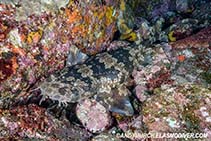
колючие лучи спинного плавника (общее число) : 0; колючие лучи анального плавника: 0. Five to six dermal flaps below and in front of eyes; back with light areas between dark saddles marked with broad reticulated dark lines (Ref. 13577). Caudal fin with its upper lobe hardly elevated above the body axis, with a strong terminal lobe and subterminal notch but no ventral lobe (Ref. 13577).
Body shape (shape guide): elongated.
A little-known bottom shark found inshore (Ref. 247); usually in sand or sandy mud bottoms (Ref. 11230); also on rocky and coral reefs (Ref. 43278). Nocturnal in habits (Ref. 247). Feeds on fish and presumably bottom invertebrates (Ref. 247), including lizardfishes, cutlassfish, horse mackerel and other jacks, goatfishes, groupers, tilefishes, sea robins, whiting, parrotfishes, sea bream, croakers, also skates, shark egg cases, cephalopods, and shrimp (Ref. 43278). Ovoviviparous (Ref. 43278, 50449), with up to 20 young in a litter (Ref. 247). Wobbegongs should be regarded as potentially dangerous because of its formidable dentition (Ref. 247, 13577). Used for human consumption (Ref. 247). Kept in aquaria in Japan and the United States (Ref. 43278).
Ovoviviparous, embryos feed solely on yolk (Ref. 50449). With up to 20 young in a litter (Ref. 247).
Compagno, L.J.V., 1984. FAO Species Catalogue. Vol. 4. Sharks of the world. An annotated and illustrated catalogue of shark species known to date. Part 1 - Hexanchiformes to Lamniformes. FAO Fish. Synop. 125(4/1):1-249. Rome, FAO. (Ref. 247)
Статус Красного Списка МСОП (Ref. 130435: Version 2025-1)
Использование человеком
рыболовство: не имеет хозяйственного значения
дополнительная информация
инструменты
Специальные отчеты
Скачать в формате XML
ресурсы в Интернет
Estimates based on models
Preferred temperature (ссылка
123201): 14.5 - 27.7, mean 24 °C (based on 222 cells).
Phylogenetic diversity index (ссылка
82804): PD
50 = 0.5012 [Uniqueness, from 0.5 = low to 2.0 = high].
Bayesian length-weight: a=0.00389 (0.00180 - 0.00842), b=3.12 (2.94 - 3.30), in cm total length, based on all LWR estimates for this body shape (Ref.
93245).
Trophic level (ссылка
69278): 3.8 ±0.57 se; based on food items.
устойчивость к внешним воздействиям (ссылка
120179): низкий, минимальное время удвоения популяции 4.5-14 лет (Fec=20).
Fishing Vulnerability (Ref.
59153): High to very high vulnerability (71 of 100).
🛈