-

- About this page
- Languages
- User feedbacks
- Citation
- Uploads
- Related species
-



Orectolobus wardi Whitley, 1939
Northern wobbegong
Add your observation in Fish Watcher
| Native range | All suitable habitat | Point map | Year 2050 |

|
| This map was computer-generated and has not yet been reviewed. |
| Orectolobus wardi AquaMaps Data sources: GBIF OBIS |
Upload your photos and videos
Pictures | Google image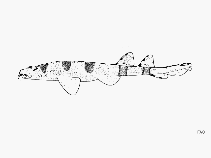 Orectolobus wardi
Picture by FAO
Pictures | Google image
Picture by FAO
Classification / Names Common names | Synonyms | Catalog of Fishes(genus, species) | ITIS | CoL | WoRMS | Cloffa
Elasmobranchii (sharks and rays) > Orectolobiformes (Carpet sharks) > Orectolobidae (Carpet or nurse sharks)
Etymology: Orectolobus: orektos (Gr.), stretched out; lobus (L.), from lobos (Gr.), rounded projection or protuberance, referring to long nasal barbels of Squalus barbatus (=O. maculatus) (See ETYFish); wardi: In honor of Australian actor, musician and naturalist Charles Melbourne Ward (1903-1966), who collected holotype (See ETYFish).
Eponymy: Charles Melbourne Ward (1903–1966) was an actor, naturalist and marine collector. [...] (Ref. 128868), visit book page.
More on author: Whitley.
Etymology: Orectolobus: orektos (Gr.), stretched out; lobus (L.), from lobos (Gr.), rounded projection or protuberance, referring to long nasal barbels of Squalus barbatus (=O. maculatus) (See ETYFish); wardi: In honor of Australian actor, musician and naturalist Charles Melbourne Ward (1903-1966), who collected holotype (See ETYFish).
Eponymy: Charles Melbourne Ward (1903–1966) was an actor, naturalist and marine collector. [...] (Ref. 128868), visit book page.
More on author: Whitley.
Environment: milieu / climate zone / depth range / distribution range Ecology
Marine; reef-associated; depth range 1 - 3 m (Ref. 43278). Tropical; 9°S - 26°S, 114°E - 154°E
Distribution Territories | FAO areas | Ecosystems | Occurrences | Point map | Introductions | Faunafri
Western Central Pacific: Australia.
Size / Weight / Age
Short description Identification keys | Morphology | Morphometrics
Dorsal spines (total): 0; Anal spines: 0. Dark rounded saddles with light outlining widely spaced by dusky areas and with a few dark spots; saddles on head and trunk forming conspicuous eyespots (Ref. 13577). Caudal fin with its upper lobe hardly elevated above the body axis, with a strong terminal lobe and subterminal notch but no ventral lobe (Ref. 13577).
Body shape (shape guide): elongated.
Body shape (shape guide): elongated.
Found on the continental shelf, commonly inshore (Ref. 247). Presumably feeds on bottom invertebrates and fishes, but diet still unrecorded (Ref. 13577, 43278). Probably ovoviviparous (Ref. 13577, 43278). Wobbegongs should be regarded as potentially dangerous because of their formidable teeth (Ref. 247, 13577).
Life cycle and mating behavior Maturity | Reproduction | Spawning | Eggs | Fecundity | Larvae
Ovoviviparous, embryos feed solely on yolk (Ref. 50449).
Main reference
Upload your references | References | Coordinator | Collaborators
Compagno, L.J.V., 1984. FAO Species Catalogue. Vol. 4. Sharks of the world. An annotated and illustrated catalogue of shark species known to date. Part 1 - Hexanchiformes to Lamniformes. FAO Fish. Synop. 125(4/1):1-249. Rome, FAO. (Ref. 247)
CITES
Not Evaluated
Threat to humans
Traumatogenic
Human uses
Fisheries: minor commercial
FAO - Fisheries: species profile; Publication: search | FishSource |
More information
Population dynamics
Growth parameters
Max. ages / sizes
Length-weight rel.
Length-length rel.
Length-frequencies
Mass conversion
Recruitment
Abundance
Growth parameters
Max. ages / sizes
Length-weight rel.
Length-length rel.
Length-frequencies
Mass conversion
Recruitment
Abundance
Life cycle
Reproduction
Maturity
Maturity/Gills rel.
Fecundity
Spawning
Spawning aggregations
Eggs
Egg development
Larvae
Larval dynamics
Reproduction
Maturity
Maturity/Gills rel.
Fecundity
Spawning
Spawning aggregations
Eggs
Egg development
Larvae
Larval dynamics
Anatomy
Gill area
Brain
Otolith
Gill area
Brain
Otolith
Physiology
Body composition
Nutrients
Oxygen consumption
Swimming type
Swimming speed
Visual pigments
Fish sound
Diseases & Parasites
Toxicity (LC50s)
Body composition
Nutrients
Oxygen consumption
Swimming type
Swimming speed
Visual pigments
Fish sound
Diseases & Parasites
Toxicity (LC50s)
Human related
Aquaculture systems
Aquaculture profiles
Strains
Ciguatera cases
Stamps, coins, misc.
Aquaculture systems
Aquaculture profiles
Strains
Ciguatera cases
Stamps, coins, misc.
Tools
E-book | Field guide | Identification keys | Length-frequency wizard | Life-history tool | Point map |
Catch-MSY |
Special reports
Download XML
Internet sources
AFORO (otoliths) | Aquatic Commons | BHL | Cloffa | Websites from users | Check FishWatcher | CISTI | Catalog of Fishes: genus, species | DiscoverLife | ECOTOX | FAO - Fisheries: species profile; Publication: search | Faunafri | Fishipedia | Fishtrace | GloBI | Google Books | Google Scholar | Google | IGFA World Record | OneZoom | Open Tree of Life | Otolith Atlas of Taiwan Fishes | PubMed | Reef Life Survey | Socotra Atlas | TreeBase | Tree of Life | Wikipedia: Go, Search |