Teleostei (teleosts) >
Callionymiformes (Dragonets) >
Callionymidae (Dragonets)
Etymology: Callionymus: Greek, kallion, comparative of kallos = beautiful + Greek, onyma = name; with a better name.
Eponymy: Harold Walter Bell Marley (1872–1945) was Principal Fisheries Officer (1918–1937) at Durban, South Africa, and a naturalist with a particular interest in entomology. [...] (Ref. 128868), visit book page.
More on author: Regan.
Environment: milieu / climate zone / depth range / distribution range
Ecology
Marine; demersal; depth range 1 - 20 m (Ref. 4405). Tropical
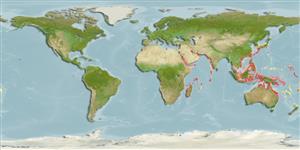
Western Indian Ocean: southern Red Sea to the Cape of Good Hope, the Persian Gulf, and southwestern India (Ref. 9608, 4405).
Size / Weight / Age
Maturity: Lm ? range ? - ? cm
Max length : 13.0 cm TL male/unsexed; (Ref. 30573); common length : 10.0 cm TL male/unsexed; (Ref. 9608)
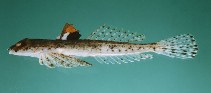
Dorsal spines (total): 4; Dorsal soft rays (total): 9; Anal spines: 0; Anal soft rays: 8. Color varies from yellow to dark brown; 1st dorsal fin of males light grey with dark lines, 1st and 4th spines longest; 1st dorsal fin of females black, 1st spine longest, 4th spine shortest (Ref. 4405).
Body shape (shape guide): elongated.
Inhabits shallow sandy bottoms (Ref. 5213). Feeds on benthic crustaceans, worms and snails (Ref. 9608).
Life cycle and mating behavior
Maturity | Reproduction | Spawning | Eggs | Fecundity | Larvae
Fricke, R., 1986. Callionymidae. p. 770-774. In M.M. Smith and P.C. Heemstra (eds.) Smiths' sea fishes. Springer-Verlag, Berlin. (Ref. 4405)
IUCN Red List Status (Ref. 130435: Version 2025-2)
Threat to humans
Harmless
Human uses
Fisheries: minor commercial
Tools
Special reports
Download XML
Internet sources