Classification / Names
आम नाम | उपशब्द | Catalog of Fishes(वर्ग, प्रजाति) | ITIS | CoL | WoRMS | Cloffa
इलाज़मौबरांकी (शारक और रेज़) (sharks and rays) >
Rhinopristiformes (Shovelnose rays) >
Rhinobatidae (Guitarfishes)
Eponymy: Dr Johann Horkel (1769–1846) was a German physician and botanist who had an example of this species, preserved in alcohol, that he provided to the authors. [...] (Ref. 128868), visit book page.
More on authors: Müller & Henle.
Environment: milieu / climate zone / गहराई सीमा / distribution range
पारिस्थितिकी
समुद्री ड़िमरसल; औशिनोड़िरोमस (Ref. 51243); गहराई सीमा 1 - 150 m (Ref. 114953). Subtropical; 24°S - 41°S, 63°W - 55°W (Ref. 114953)
Western South Atlantic: From Rio de Janeiro to Argentina.
आकार / वज़न / Age
परिपक्व अवधि: Lm ? range ? - ? cm
Max length : 138 cm TL पुल्लिंग / अलिंग; (Ref. 57911); common length : 60.0 cm TL पुल्लिंग / अलिंग; (Ref. 6077)
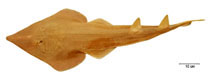
Nostrils are longer, crown is flat transversely or even slightly convex, tubercles in median row are larger, thorn like, numerous. Origin of first dorsal is posterior to the tips of pelvic fins, equal to the base of first dorsal. Upper surface uniform olive gray or chocolate brown, without pale or dark markings. Snout with an oval sooty patch (Ref. 6902).
Body shape (shape guide): elongated.
Found from the coast line to the continental edge. Females mature at ca. 90 cm TL (Ref. 114953). Feeds on crustaceans, cephalopods, polychaetes and small fishes. Ovoviviparous (Ref. 50449). Produces litters of 4-12 pups (Ref. 114953).
Life cycle and mating behavior
परिपक्व अवधि | पुनरुत्पत्ति | मछलीऔ का अंडे देना | अंडे | Fecundity | लार्वा
Exhibit ovoviparity (aplacental viviparity), with embryos feeding initially on yolk, then receiving additional nourishment from the mother by indirect absorption of uterine fluid enriched with mucus, fat or protein through specialised structures (Ref. 50449).
Compagno, L.J.V., 1999. Checklist of living elasmobranchs. p. 471-498. In W.C. Hamlett (ed.) Sharks, skates, and rays: the biology of elasmobranch fishes. Johns Hopkins University Press, Maryland. (Ref. 35766)
IUCN Red List Status (Ref. 130435: Version 2025-1)
Threat to humans
Harmless
Human uses
मात्स्यिकी: व्यापारिक
साधन
Special reports
Download XML
इंटरनेट स्रोत
Estimates based on models
Preferred temperature (संदर्भ
123201): 11.6 - 22.7, mean 15.6 °C (based on 248 cells).
Phylogenetic diversity index (संदर्भ
82804): PD
50 = 0.5020 [Uniqueness, from 0.5 = low to 2.0 = high].
Bayesian length-weight: a=0.00282 (0.00134 - 0.00591), b=3.12 (2.95 - 3.29), in cm total length, based on LWR estimates for this Genus-body shape (Ref.
93245).
Trophic level (संदर्भ
69278): 3.8 ±0.49 se; based on food items.
लौटाव (संदर्भ
120179): बहुत नीचे, न्यूनतम जनसंख्या दुगनी समय अवलागत 14 महीने। (Fec=4-12).
Fishing Vulnerability (Ref.
59153): Very high vulnerability (83 of 100).
🛈