Teleostei (teleosts) >
Cichliformes (Cichlids, convict blennies) >
Cichlidae (Cichlids) > Etroplinae
Etymology: Paretroplus: Name from the Greek 'para' meaning 'on the side of'; in taxonomy it is commonly used in generic names to express similarity or relatedness; in the present case it would mean 'next to Etroplus' (S.Kullander, pers.comm. 3/11).
Environment: milieu / climate zone / depth range / distribution range
Ecology
Freshwater; demersal. Tropical; 13°S - 20°S
Africa: northwest Madagascar (Ref. 5675) in Betsiboka River drainage (Ref. 78623).
Size / Weight / Age
Maturity: Lm ? range ? - ? cm
Max length : 14.8 cm SL male/unsexed; (Ref. 78623)
Short description
Identification keys | Morphology | Morphometrics
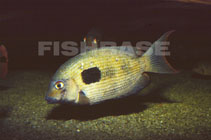
Dorsal spines (total): 15 - 18; Dorsal soft rays (total): 16 - 20; Anal spines: 8 - 10; Anal soft rays: 13 - 16. Diagnosis: A member of the deep-bodied clade of Paretroplus and distinguished from all congeners by the presence of a large and essentially square to rounded solid black pectoral patch, located above and slightly posterior to the pectoral-fin base, and generally not extending dorsal to the upper branch of the lateral line (Ref. 78623).
Body shape (shape guide): fusiform / normal.
Life cycle and mating behavior
Maturity | Reproduction | Spawning | Eggs | Fecundity | Larvae
Sparks, J.S., 2008. Phylogeny of the cichlid subfamily Etroplinae and taxonomic revision of the Malagasy cichlid genus Paretroplus (Teleostei: Cichlidae). Bull. Am. Mus. Nat. Hist. 314:1-151. (Ref. 78623)
IUCN Red List Status (Ref. 130435: Version 2025-2)
Threat to humans
Harmless
Human uses
Tools
Special reports
Download XML
Internet sources