Teleostei (teleosts) >
Anguilliformes (Eels and morays) >
Derichthyidae (Longneck eels)
Etymology: Nessorhamphus: Greek, nessa, netta = duck + Greek, rhamphos = bill, peak (Ref. 45335).
Environment: milieu / climate zone / depth range / distribution range
Ecology
Marine; bathypelagic; depth range 0 - 1800 m (Ref. 58018). Deep-water
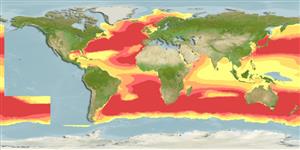
Eastern Atlantic: France to Morocco; off the Cape, South Africa (Ref. 6592). Also known from temperate and subtropical latitudes of the western Atlantic, southwestern Indian, and southwest Pacific.
Size / Weight / Age
Maturity: Lm ? range ? - ? cm
Max length : 60.0 cm TL male/unsexed; (Ref. 123983)
Dorsal spines (total): 0; Anal spines: 0. Dark brown in color (Ref. 6592). Snout long, depressed, and spatulate in form; lateral line distinct; pectoral fin long, subequal to snout; dorsal and anal fin rays abruptly become shorter near tip of tail and once again become longer, so it appears an independent caudal fin is present (Ref. 13608).
Body shape (shape guide): eel-like.
Mesopelagic (Ref. 5951). Feeds mainly on crustaceans.
Life cycle and mating behavior
Maturity | Reproduction | Spawning | Eggs | Fecundity | Larvae
Smith, D.G., 1990. Derichthyidae. p. 193-194. In J.C. Quero, J.C. Hureau, C. Karrer, A. Post and L. Saldanha (eds.) Check-list of the fishes of the eastern tropical Atlantic (CLOFETA). JNICT, Lisbon; SEI, Paris; and UNESCO, Paris. Vol. 1. (Ref. 5228)
IUCN Red List Status (Ref. 130435: Version 2025-2)
Threat to humans
Harmless
Human uses
Tools
Special reports
Download XML
Internet sources