Teleostei (teleosts) >
Pleuronectiformes (Flatfishes) >
Paralichthyidae (Large-tooth flounders)
Etymology: Paralichthys: Greek, para = the side of + Greek, ichthys = fish + Greek, suffix, oides = similar to (Ref. 45335).
More on authors: Jordan & Gilbert.
Environment: milieu / climate zone / depth range / distribution range
Ecology
Marine; demersal; depth range 19 - 130 m (Ref. 26938). Subtropical; 37°N - 7°N, 98°W - 59°W
Western Atlantic: North Carolina to southern Florida, USA, northern Bahamas, Gulf of Mexico, Caribbean Sea, Colombia to Trinidad and Tobago.
Size / Weight / Age
Maturity: Lm ? range ? - ? cm
Max length : 71.0 cm TL male/unsexed; (Ref. 26938); common length : 35.0 cm TL male/unsexed; (Ref. 3275); max. published weight: 2.8 kg (Ref. 40637)
Short description
Identification keys | Morphology | Morphometrics
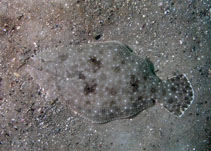
Occurs in bays, lagoons and shallow coastal waters (Ref. 7251). Inhabits mainly hard and sandy bottoms (Ref. 3275).
Life cycle and mating behavior
Maturity | Reproduction | Spawning | Eggs | Fecundity | Larvae
Distinct pairing (Ref. 205).
Robins, C.R. and G.C. Ray, 1986. A field guide to Atlantic coast fishes of North America. Houghton Mifflin Company, Boston, U.S.A. 354 p. (Ref. 7251)
IUCN Red List Status (Ref. 130435: Version 2025-2)
Threat to humans
Harmless
Human uses
Fisheries: minor commercial; gamefish: yes
Tools
Special reports
Download XML
Internet sources