



Potamotrygon motoro (Müller & Henle, 1841)
South American freshwater stingrayPictures | Google image
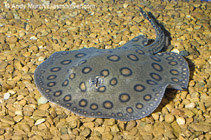
Picture by Murch, A.
Classification / Names Common names | Synonyms | Catalog of Fishes(genus, species) | ITIS | CoL | WoRMS | Cloffa
Etymology: Potamotrygon: Greek, potamos = river + Greek, trygon = a sting ray (Ref. 45335).
More on authors: Müller & Henle.
Taxonomic Remarks
Authorship of species is credited to Müller & Henle (1841) and not Naterrer (who collected the type specimen) as in Rosa (1985a). A widespread species that may require further subdivision after more study. Studies of its reproductive biology indicate that females attain sexual maturity between 24 and 32 cm DW (males between 20 and 30 cm DW), and may produce from three to 21 embryos per gestation (Achenbach & Achencbach, 1976) or only six or seven (Thorson et al., 1983b; these differences may be populational). Larger specimens may weigh 10 kg. This species has been captively bred in aquaria, but is still the most comercially imported species by the aquarium industry. Additional references: Bertin (1939), Castex & Castello (1970b), Achenbach & Achenbach (1976), Thorson et al. (1983b), Sérét & McEachran (1986), Ortega & Vari (1986), Paepke & Schmidt (1988), Barriga (1991), Compagno & Cook (1995), Lasso et al. (1997a), Ferreira et al. (1998), Britski et al. (1999).
Environment: milieu / climate zone / depth range / distribution range Ecology
Distribution Territories | FAO areas | Ecosystems | Occurrences | Point map | Introductions | Faunafri
Size / Weight / Age
Max length : 50.0 cm WD male/unsexed; (Ref. 36687); max. published weight: 34.2 kg (Ref. 85107)
Life cycle and mating behavior Maturity | Reproduction | Spawning | Eggs | Fecundity | Larvae
Main reference
Upload your references | References | Coordinator : Carvalho, Marcelo | Collaborators
IUCN Red List Status (Ref. 130435: Version 2025-2 (Global))
Threat to humans
Human uses
More information
Food items (preys)
Diet composition
Food consumption
Food rations
Predators
Ecology
Growth parameters
Max. ages / sizes
Length-weight rel.
Length-length rel.
Length-frequencies
Mass conversion
Recruitment
Abundance
Reproduction
Maturity
Maturity/Gills rel.
Fecundity
Spawning
Spawning aggregations
Eggs
Egg development
Larvae
Larval dynamics
Body composition
Nutrients
Oxygen consumption
Swimming type
Swimming speed
Visual pigments
Fish sound
Diseases & Parasites
Toxicity (LC50s)
Genome
Genetics
Heterozygosity
Heritability
Genetic Diversity
Aquaculture systems
Aquaculture profiles
Strains
Ciguatera cases
Stamps, coins, misc.
Tools
Special reports
Download XML
Internet sources
Estimates based on models
|
Phylogenetic diversity index (Ref. 82804) |
PD50 = 0.5000 [Uniqueness, from 0.5 = low to 2.0 = high]. |
| Bayesian length-weight | a=0.01000 (0.00244 - 0.04107), b=3.04 (2.81 - 3.27), in cm total length, based on all LWR estimates for this body shape (Ref. 93245). |
|
Trophic level (Ref. 69278) |
3.2 ±0.4 se; based on size and trophs of closest relatives |
| Generation time | 6.5 ( na - na) years. Estimated as median ln(3)/K based on 2 growth studies. |
|
Resilience (Ref. 120179) |
Low, minimum population doubling time 4.5 - 14 years (Fec=16). |
|
Fishing Vulnerability (Ref. 59153) |
Moderate to high vulnerability (53 of 100). 🛈 |
|
Price category (Ref. 80766) |
Medium. |