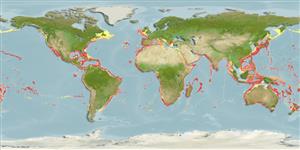
Environment: milieu / climate zone / distribuzione batimetrica / distribution range
Ecologia
marino benthopelagico; oceanodromo (Ref. 51243); distribuzione batimetrica 100 - 975 m (Ref. 9302), usually 200 - 400 m (Ref. 6181). Subtropical; 55°N - 43°S, 180°W - 180°E (Ref. 6181)
Circumtropical and Circumtemperate
Size / Peso / Age
Maturità: Lm ? range ? - ? cm
Max length : 300 cm TL maschio/sesso non determinato; (Ref. 5951); common length : 150 cm SL maschio/sesso non determinato; (Ref. 6181); peso massimo pubblicato: 63.5 kg (Ref. 4699)
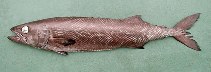
Spine dorsali (totale) : 13 - 15; Raggi dorsali molli (totale) : 15 - 18; Spine anali: 0; Raggi anali molli: 15 - 18; Vertebre: 32. Skin very rough, scales interspersed with spinous bony tubercles. Mid-ventral (abdominal) keel on the ventral contour. Body is uniformly brown to dark brown, tips of the pectoral and pelvic fins black, margins of the second dorsal and anal fins white in young specimens.
Body shape (shape guide): elongated; Cross section: compressed.
Usually over the continental shelf, sometimes in oceanic waters down to 800 m (Ref. 9302). Usually solitary or in pairs near the bottom (Ref. 6181). Migrates far offshore (Ref. 26139). Pelagic (Ref. 5951). Feeds on fish, crustaceans and squid (Ref. 6181). The peculiar wooden 'palu' or Ruvettus hook is used to catch this species in south central Pacific (Ref. 6181). The flesh is very oily, with purgative properties, if eaten much (Ref. 6181). Marketed fresh and as fish cakes in Japan (Ref. 9302); also processed into fishmeal (Ref. 5217). Maximum length reported to reach up to 2 m only (Heemstra, pers. comm. 03/03).
Life cycle and mating behavior
Maturità | Riproduzione | Deposizione | Uova | Fecundity | Larve
Nakamura, I. and N.V. Parin, 1993. FAO Species Catalogue. Vol. 15. Snake mackerels and cutlassfishes of the world (families Gempylidae and Trichiuridae). An annotated and illustrated catalogue of the snake mackerels, snoeks, escolars, gemfishes, sackfishes, domine, oilfish, cutlassfishes,. scabbardfishes, hairtails, and frostfishes known to date. FAO Fish. Synop. 125(15):136 p. (Ref. 6181)
IUCN Red List Status (Ref. 130435: Version 2025-1)
Threat to humans
Poisonous to eat (Ref. 4690)
Human uses
Pesca: scarso interesse commerciale; Pesce da pesca sportiva: si
Strumenti
Special reports
Download XML
Fonti Internet
Estimates based on models
Preferred temperature (Fonte Biblio.
123201): 8.6 - 19, mean 12.9 °C (based on 603 cells).
Phylogenetic diversity index (Fonte Biblio.
82804): PD
50 = 1.0000 [Uniqueness, from 0.5 = low to 2.0 = high].
Bayesian length-weight: a=0.00347 (0.00190 - 0.00632), b=3.10 (2.93 - 3.27), in cm total length, based on LWR estimates for this species & (Sub)family-body (Ref.
93245).
Trophic level (Fonte Biblio.
69278): 4.2 ±0.57 se; based on food items.
Resilienza (Fonte Biblio.
120179): Basso, tempo minimo di raddoppiamento della popolazione 4.5 - 14 anni (Assuming tm>4).
Prior r = 0.28, 95% CL = 0.19 - 0.42, Based on 1 data-limited stock assessment.
Fishing Vulnerability (Ref.
59153): Very high vulnerability (90 of 100).
🛈
Climate Vulnerability (Ref.
125649): Moderate vulnerability (38 of 100).
🛈
Nutrients (Ref.
124155): Calcium = 17.3 [7.8, 32.2] mg/100g; Iron = 0.573 [0.271, 1.108] mg/100g; Protein = 17.7 [15.5, 19.7] %; Omega3 = 0.202 [0.110, 0.353] g/100g; Selenium = 81.8 [36.6, 171.9] μg/100g; VitaminA = 10.3 [3.2, 36.7] μg/100g; Zinc = 0.411 [0.288, 0.611] mg/100g (wet weight);