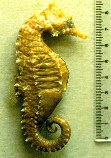
Hippocampus erectus, Lined seahorse : fisheries, aquarium

Hippocampus erectus Perry, 1810

Lined seahorse
Waarneming toevoegen in Fish Watcher
Native range | All suitable habitat | Point map | Year 2050
This map was computer-generated and has not yet been reviewed.
Hippocampus erectus   AquaMaps   Data sources: GBIF OBIS
Uploaden van uw Foto's en video's
Afbeeldingen | Geluiden | Postzegels, munten, diversen. | Google afbeelding

Classificatie / Namen Lokale namen | Synoniemen | Catalog of Fishes(Genus, Soort(en)) | ITIS | CoL | WoRMS | Cloffa

> Syngnathiformes (Pipefishes and seahorses) > Syngnathidae (Pipefishes and seahorses) > Syngnathinae
Etymology: Hippocampus: Greek, ippos = horse + Greek,kampe = curvature (Ref. 45335).

Milieu: milieu / Klimaatzone / Diepte / verspreidingsgebied Ecologie

marien rifbewoner; standvastig; diepte 0 - 100 m (Ref. 128812). Subtropical; 10°C - 27°C (Ref. 36630); 50°N - 32°S, 98°W - 32°W (Ref. 52034)

Verspreiding Gebieden | FAO regio's | Ecosystemen | Voorkomen | Verspreidingskaart | Introducties | Faunafri

Western Atlantic: Canada (off Scotian shelf) to Brazil; including countries of the Gulf of Mexico and the West Indies. A southern form that may prove to be a separate species is known from Rio de Janeiro, Brazil and questionably from Suriname.

Lengte bij maturiteit / Grootte / Gewicht / Leeftijd

Maturiteit: Lm 6.3  range ? - ? cm
Max length : 17.8 cm SL mannelijk / geslacht onbekend; (Ref. 137577); max. gerapporteerde leeftijd: 1.00 Jaren (Ref. 1285)

Korte beschrijving Determinatiesleutels | Morfologie | Morfometrie

Dorsale stekels (totaal) : 0; Dorsale zachte stralen (totaal) : 16 - 20.
Body shape (shape guide): other.

Biologie     Verklarende woordenlijst (bv. epibenthic)

Generally in coastal waters; often around man-made structures (Ref. 26938). Usually attached to gorgonians or seagrasses but may occur in floating Sargassum or swimming freely in midwater (Ref. 9710). Those that live in Sargassum usually have bony protuberances and fleshy tabs that may serve as camouflage. Has been reared in captivity (Ref. 35420, 35422). Move into deeper waters during winter (Ref. 36630). Feeds by sucking in small organisms, using its long face as a pipette (Ref. 26938); like small crustaceans (Ref. 27549). Ovoviviparous (Ref. 205). The male carries the eggs in a brood pouch which is found under the tail (Ref. 205). Length type refers to Height (= from top of coronet to the tip of straightened tail).

Levenscyclus en paargedrag Maturiteit | Voortplanting | Paaien | Eieren | Fecunditeit | Larven

Incubates eggs in an external marsupium. Gestation period 20-21 days but varies with water temperature (Ref. 30915).

Hoofdreferentie Upload uw referenties | Referenties | Coördinator | Medewerkers

Lourie, S.A., R.A. Pollom and S.J. Foster, 2016. A global revision of the seahorses Hippocampus Rafinesque 1810 (Actinopterygii: Syngnathiformes): taxonomy and biogeography with recommendations for further research. Zootaxa 4146(1):1-66. (Ref. 115213)

Status op de Rode Lijst van het IUCN (Ref. 130435: Version 2025-2 (Global))

  Kwetsbaar (VU) (A2cd); Date assessed: 03 October 2016

CITES


CMS (Ref. 116361)

Not Evaluated

Gevaar voor de mens

  Harmless


Gebruik door de mens

Visserij: van minder commercieel belang; Aquarium: Commercieel
FAO - Publication: search | FishSource | Sea Around Us

Meer informatie

Trofische ecologie
Voedsel (prooien)
Dieetsamenstelling
Voedselconsumptie
Voedselrantsoenen
Predatoren
Ecologie
Ecologie
Populatiedynamica
Groeiparameters
Max. leeftijden / maten
Lengte-gewicht rel.
Lengte-lengte rel.
Lengtefrequenties
Massaconversie
Rekrutering
Abundantie
Levenscyclus
Voortplanting
Maturiteit
Rijpheid/kieuwen rel.
Fecunditeit
Paaien
Paaibestanden
Eieren
Ontwikkeling van de eieren
Larven
Larvale populatiedynamiek
Verspreiding
Gebieden
FAO regio's
Ecosystemen
Voorkomen
Introducties
BRUVS - Video's
Anatomie
Kieuwoppervlak
Hersenen
Otoliet
Fysiologie
Lichaamssamenstelling
Voedingsstoffen
Zuurstofverbruik
Type zwemmen
Zwemsnelheid
Visuele pigmenten
Vis geluid
Ziekten en parasieten
Toxiciteit (LC50)
Genetica
genoom
Genetica
Heterozygositeit
Erfelijkheid
Genetische diversiteit
Menselijk gerelateerd
Aquacultuursystemen
Aquacultuurprofielen
Kweeklijnen
Ciguatera gevallen
Postzegels, munten, diversen.
Outreach
Medewerkers
Referenties
Referenties

Tools

Speciale rapporten

Download XML

Internetbronnen

Schattingen op basis van modellen

Gewenste temperatuur (Ref. 123201): 12.1 - 27, mean 24 °C (based on 144 cells).
Fylogenetische diversiteitsindex (Ref. 82804):  PD50 = 0.5000   [Uniqueness, from 0.5 = low to 2.0 = high].
Bayesian length-weight: a=0.00447 (0.00176 - 0.01132), b=3.00 (2.78 - 3.22), in cm total length, based on LWR estimates for this (Sub)family-body shape (Ref. 93245).
Trofisch niveau (Ref. 69278):  3.5   ±0.51 se; based on food items.
Generation time: 3.2 ( na - na) years. Estimated as median ln(3)/K based on 1 growth studies.
Weerstandsvermogen (Ref. 120179):  Hoog, minimale populatieverdubbelingstijd minder dan 15 maanden (K=0.34; tmax=1; Fec=1,552).
Kwetsbaarheid van de visserij (Ref. 59153):  Low to moderate vulnerability (31 of 100). 🛈
Prijsklasse (Ref. 80766):   Unknown.
Voedingsstoffen (Ref. 124155):  Calcium = 47.1 [22.2, 120.5] mg/100g; Iron = 0.62 [0.33, 1.15] mg/100g; Protein = 18.5 [17.4, 19.7] %; Omega3 = 0.186 [0.102, 0.333] g/100g; Selenium = 15.1 [6.8, 35.8] μg/100g; VitaminA = 78.1 [23.5, 255.2] μg/100g; Zinc = 0.985 [0.614, 1.530] mg/100g (wet weight);