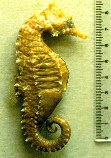
Hippocampus erectus, Lined seahorse : fisheries, aquarium

Hippocampus erectus Perry, 1810

Lined seahorse
Aggiungete la vostra osservazione in Fish Watcher
Native range | All suitable habitat | Point map | Year 2050
This map was computer-generated and has not yet been reviewed.
Hippocampus erectus   AquaMaps   Data sources: GBIF OBIS
Carica il tuo foto e Video
Immagini | Suoni | Francobolli, monete, materiale vario. | Google image

Classificazione / Nomi Nomi Comuni | Sinonimi | Catalog of Fishes(Genere, Specie) | ITIS | CoL | WoRMS | Cloffa

> Syngnathiformes (Pipefishes and seahorses) > Syngnathidae (Pipefishes and seahorses) > Syngnathinae
Etymology: Hippocampus: Greek, ippos = horse + Greek,kampe = curvature (Ref. 45335).

Ambiente: milieu / zona climatica / distribuzione batimetrica / gamma di distribuzione Ecologia

marino associati a barriera corallina; non migratori; distribuzione batimetrica 0 - 100 m (Ref. 128812). Subtropical; 10°C - 27°C (Ref. 36630); 50°N - 32°S, 98°W - 32°W (Ref. 52034)

Distribuzione Territories | Aree FAO | Ecosistemi | Presenze | Mappa dei ritrovamenti | Introduzioni | Faunafri

Western Atlantic: Canada (off Scotian shelf) to Brazil; including countries of the Gulf of Mexico and the West Indies. A southern form that may prove to be a separate species is known from Rio de Janeiro, Brazil and questionably from Suriname.

Lunghezza alla prima maturità / Dimensione / Peso / Età

Maturità: Lm 6.3  range ? - ? cm
Max length : 17.8 cm SL maschio/sesso non determinato; (Ref. 137577); Età massima riportata: 1.00 anni (Ref. 1285)

Breve descrizione Chiavi di identificazione | Morfologia | Morfometria

Spine dorsali (totale) : 0; Raggi dorsali molli (totale) : 16 - 20.
Body shape (shape guide): other.

Biologia     Glossario (es. epibenthic)

Generally in coastal waters; often around man-made structures (Ref. 26938). Usually attached to gorgonians or seagrasses but may occur in floating Sargassum or swimming freely in midwater (Ref. 9710). Those that live in Sargassum usually have bony protuberances and fleshy tabs that may serve as camouflage. Has been reared in captivity (Ref. 35420, 35422). Move into deeper waters during winter (Ref. 36630). Feeds by sucking in small organisms, using its long face as a pipette (Ref. 26938); like small crustaceans (Ref. 27549). Ovoviviparous (Ref. 205). The male carries the eggs in a brood pouch which is found under the tail (Ref. 205). Length type refers to Height (= from top of coronet to the tip of straightened tail).

Ciclo vitale e comportamento di accoppiamento Maturità | Riproduzione | Deposizione | Uova | Fecondità | Larve

Incubates eggs in an external marsupium. Gestation period 20-21 days but varies with water temperature (Ref. 30915).

Riferimento principale Caricare le referenze | Bibliografia | Coordinatore | Collaboratori

Lourie, S.A., R.A. Pollom and S.J. Foster, 2016. A global revision of the seahorses Hippocampus Rafinesque 1810 (Actinopterygii: Syngnathiformes): taxonomy and biogeography with recommendations for further research. Zootaxa 4146(1):1-66. (Ref. 115213)

Stato della Lista Rossa IUCN (Ref. 130435: Version 2025-2 (Global))

  Vulnerabile (VU) (A2cd); Date assessed: 03 October 2016

CITES


CMS (Ref. 116361)

Not Evaluated

Minaccia per l'uomo

  Harmless


Usi umani

Pesca: scarso interesse commerciale; Acquario: Commerciale
FAO - Publication: search | FishSource | Sea Around Us

Informazioni ulteriori

Ecologia trofica
Articoli alimentari (prede)
Alimentazione
Consumo di cibo
Razioni alimentari
Predatori
Ecologia
Ecologia
Dinamica della popolazione
Parametri di crescita
Età massima / dimensioni massime
Rapporto lunghezza-peso.
Lunghezza-lunghezza rel.
Lunghezza-frequenze
Conversione di massa
Reclutamento
Abbondanza
Ciclo di vita
Riproduzione
Maturità
Maturità/Gli occhielli sono relativi.
Fecondità
Deposizione
Aggregazioni riproduttive
Uova
Sviluppo delle uova
Larve
Dinamica popolazioni larvali
Distribuzione
Territories
Aree FAO
Ecosistemi
Presenze
Introduzioni
BRUVS - Video
Anatomia
Area branchiale
Cervello
Otolite
Fisiologia
Composizione corporea
Nutrienti
Consumo di ossigeno
Tipo di nuoto
Velocità di nuoto
Pigmenti visivi
Suono del pesce
Malattie e parassiti
Tossicità (LC50)
Genetica
Genome
Genetica
Eterozigosi
Ereditarietà
Diversità genetica
Legato all'uomo
Sistemi di acquacoltura
Profili di acquacoltura
Varietà
Casi di Ciguatera
Francobolli, monete, materiale vario.
Raggiungimento
Collaboratori
Bibliografia
Bibliografia

Strumenti

Rapporti speciali

Scarica XML

Fonti Internet

Stime basate su modelli

Temperatura preferita (Fonte Biblio. 123201): 12.1 - 27, mean 24 °C (based on 144 cells).
Indice di diversità filogenetica (Fonte Biblio. 82804):  PD50 = 0.5000   [Uniqueness, from 0.5 = low to 2.0 = high].
Bayesian length-weight: a=0.00447 (0.00176 - 0.01132), b=3.00 (2.78 - 3.22), in cm total length, based on LWR estimates for this (Sub)family-body shape (Ref. 93245).
Livello trofico (Fonte Biblio. 69278):  3.5   ±0.51 se; based on food items.
Generation time: 3.2 ( na - na) years. Estimated as median ln(3)/K based on 1 growth studies.
Resilienza (Fonte Biblio. 120179):  Alto, tempo minimo di raddoppiamento della popolazione meno di 15 mesi (K=0.34; tmax=1; Fec=1,552).
Vulnerabilità della pesca (Ref. 59153):  Low to moderate vulnerability (31 of 100). 🛈
Categoria di prezzo (Ref. 80766):   Unknown.
Nutrienti (Ref. 124155):  Calcium = 47.1 [22.2, 120.5] mg/100g; Iron = 0.62 [0.33, 1.15] mg/100g; Protein = 18.5 [17.4, 19.7] %; Omega3 = 0.186 [0.102, 0.333] g/100g; Selenium = 15.1 [6.8, 35.8] μg/100g; VitaminA = 78.1 [23.5, 255.2] μg/100g; Zinc = 0.985 [0.614, 1.530] mg/100g (wet weight);