



Trichogenes longipinnis Britski & Ortega, 1983
Long-finned cambeva
Adicionar o seu Fotografias e vídeos
Fotografias | Imagem do Google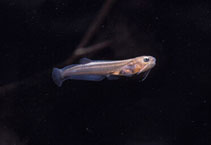 Trichogenes longipinnis
Fotografia de Sazima, I.
Fotografias | Imagem do Google
Fotografia de Sazima, I.
Classificação / Nomes Nomes comuns | Sinónimos | Catalog of Fishes(Género, Espécies) | ITIS | CoL | WoRMS | Cloffa
> Siluriformes (Catfishes) > Trichomycteridae (Pencil or parasitic catfishes) > Trichogeninae
Etymology: Trichogenes: Greek, thrix = hair + Greek, genes, genesis = birth, race (Ref. 45335).
Etymology: Trichogenes: Greek, thrix = hair + Greek, genes, genesis = birth, race (Ref. 45335).
Ambiente: milieu / zona climática / intervalo de profundidade / gama de distribuição Ecologia
; Água doce demersal. Tropical; 20°C - 24°C (Ref. 13614)
Distribuição Territórios | Áreas FAO | Ecossistemas | Ocorrências | Mapa dos pontos | Introduções | Faunafri
South America: coastal streams between Rio de Janeiro and São Paulo States, Southeastern Brazil. Due to restricted distribution, specialized habitat, and differentiated populations, the vulnerable (VU B1+2bc) status in the IUCN List is proposed (Ref. 50917).
Tamanho / Peso / Idade
Maturidade: Lm ? range ? - ? cm
Max length : 14.0 cm SL macho/indeterminado; (Ref. 50917); 10.6 cm SL (female)
Max length : 14.0 cm SL macho/indeterminado; (Ref. 50917); 10.6 cm SL (female)
Found in streams in the Atlantic forest; backwaters with no flow to 0.44 meter per second water flow. Dwells mostly in pools beneath small waterfalls in steep hill streams flowing over rocky and sandy substrates. Density varies from 3 to 25 individuals per square meter. At densities of 18 to 25 individuals per square meter, fish aggregates in loose groups of up to 30 individuals; largest ones tend to be solitary and territorial. Nektonic, active both during daytime and at night; juveniles and small adults of up to 9 cm TL are more active at daytime, whereas larger ones are active mostly at night. Uses visual, tactile, and chemo-sensory orientation to feed on bottom-dwelling aquatic and terrestrial arthropods in the water column or on the surface. Diet includes immature aquatic insects, crustaceans, adult terrestrial winged insects whole or fragmented, as well as carrion. Forages mostly by scanning the bottom, the barbels touching the substrate, but visual oriented drift feeding is also employed by individuals up to 5 cm TL. While foraging may bury into sand or plant debris and sifts through opercular openings and mouth. Reproduces at the onset of rainy season (austral summer). Mature oocytes about 0.2 cm diameter; pterigyolarvae range 1-1.5 cm TL. Spotted color pattern differs consistently between stream populations, an indication of genetic differentiation (Ref. 50917).
Ciclo de vida e comportamento de acasalamento Maturidade | Reprodução | Desova | Ovos | Fecundidade | Larvas
Referência principal
Carregar as suas referências | Referências | Coordenador : Pinna, Mário de | Colaboradores
Burgess, W.E., 1989. An atlas of freshwater and marine catfishes. A preliminary survey of the Siluriformes. T.F.H. Publications, Inc., Neptune City, New Jersey (USA). 784 p. (Ref. 6868)
Categoria na Lista Vermelha da IUCN (Ref. 130435: Version 2025-2 (Global))
Quase ameaçada (NT) (B1b(iii)); Date assessed: 07 November 2018
CITES
Not Evaluated
Ameaça para o homem
Harmless
Utilização humana
Pescarias: pescarias de subsistência
FAO - Publication: search | FishSource |
Mais informação
Ecologia Trófica
Produtos alimentares (presas)
Composição da dieta
Consumo alimentar
Rações alimentares
Predadores
Produtos alimentares (presas)
Composição da dieta
Consumo alimentar
Rações alimentares
Predadores
Dinâmica das populações
Parâmetros de crescimento
Idades / tamanhos máximos
Comprimento-peso rel.
Comprimento-comprimento rel.
Frequência de comprimento
Conversão de massa
Recrutamento
Abundância
Parâmetros de crescimento
Idades / tamanhos máximos
Comprimento-peso rel.
Comprimento-comprimento rel.
Frequência de comprimento
Conversão de massa
Recrutamento
Abundância
Ciclo de vida
Reprodução
Maturidade
Maturidade/Rel. das guelras
Fecundidade
Desova
Agregações de desova
Ovos
Desenvolvimento dos ovos
Larvas
Dinâmica larvar
Reprodução
Maturidade
Maturidade/Rel. das guelras
Fecundidade
Desova
Agregações de desova
Ovos
Desenvolvimento dos ovos
Larvas
Dinâmica larvar
Anatomia
Área branquial
Cérebro
Otólitos
Área branquial
Cérebro
Otólitos
Fisiologia
Composição corporal
Nutrientes
Consumo de oxigénio
Tipo de natação
Velocidade de natação
Pigmentos visuais
Som de peixe
Doenças e Parasitas
Toxicidade (LC50s)
Composição corporal
Nutrientes
Consumo de oxigénio
Tipo de natação
Velocidade de natação
Pigmentos visuais
Som de peixe
Doenças e Parasitas
Toxicidade (LC50s)
Relacionado com o ser humano
Sistemas de aquacultura
Perfis para aquacultura
Estirpes
Casos de Ciguatera
Selos, moedas, diversos.
Sistemas de aquacultura
Perfis para aquacultura
Estirpes
Casos de Ciguatera
Selos, moedas, diversos.
Ferramentas
Questionário orgânico | E-book | Guia de campo | Ferramenta auxiliar de frequências de comprimento | Ferramenta sobre a história de vida | Mapa dos pontos |
Captura-MSY |
Relatórios especiais
Descarregue XML
Fontes da internet
AFORO (otoliths) | Aquatic Commons | BHL | Cloffa | Websites from users | Consultar FishWatcher | CISTI | Catalog of Fishes: Género, Espécies | DiscoverLife | ECOTOX | FAO - Publication: search | Faunafri | Fishipedia | Fishtrace | GloBI | Google Books | Google Scholar | Google | IGFA World Record | OneZoom | Open Tree of Life | Otolith Atlas of Taiwan Fishes | PubMed | Reef Life Survey | Socotra Atlas | TreeBase | Árvore da vida | Wikipedia: ir para, procurar | World Records Freshwater Fishing | Zoobank | Registo zoológico
Estimativas baseadas em modelos
Índice de diversidade filogenética (Ref. 82804): PD50 = 0.7500 [Uniqueness, from 0.5 = low to 2.0 = high].
Bayesian length-weight: a=0.00389 (0.00180 - 0.00842), b=3.12 (2.94 - 3.30), in cm total length, based on all LWR estimates for this body shape (Ref. 93245).
Nível Trófico (Ref. 69278): 3.4 ±0.46 se; based on food items.