



Trichogenes longipinnis Britski & Ortega, 1983
Long-finned cambeva
Hochladen Photos und videos
Bilder | Google Bild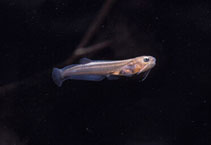 Trichogenes longipinnis
Photo von Sazima, I.
Bilder | Google Bild
Photo von Sazima, I.
Klassifizierung / Names Namen | Synonyme | Catalog of Fishes(Gattung, Arten) | ITIS | CoL | WoRMS | Cloffa
> Siluriformes (Catfishes) > Trichomycteridae (Pencil or parasitic catfishes) > Trichogeninae
Etymology: Trichogenes: Greek, thrix = hair + Greek, genes, genesis = birth, race (Ref. 45335).
Etymology: Trichogenes: Greek, thrix = hair + Greek, genes, genesis = birth, race (Ref. 45335).
Umwelt: Milieu / Klimazone / Tiefenbereich / Verbreitungsgebiet Ökologie
; süßwasser demersal. Tropical; 20°C - 24°C (Ref. 13614)
Verbreitung Territorien | FAO Gebiete | Ökosysteme | Vorkommen | Punkt Karte | Einführungen | Faunafri
South America: coastal streams between Rio de Janeiro and São Paulo States, Southeastern Brazil. Due to restricted distribution, specialized habitat, and differentiated populations, the vulnerable (VU B1+2bc) status in the IUCN List is proposed (Ref. 50917).
Größe / Gewicht / Alter
Geschlechtsreife: Lm ? range ? - ? cm
Max length : 14.0 cm SL Männchen/unbestimmt; (Ref. 50917); 10.6 cm SL (female)
Max length : 14.0 cm SL Männchen/unbestimmt; (Ref. 50917); 10.6 cm SL (female)
Found in streams in the Atlantic forest; backwaters with no flow to 0.44 meter per second water flow. Dwells mostly in pools beneath small waterfalls in steep hill streams flowing over rocky and sandy substrates. Density varies from 3 to 25 individuals per square meter. At densities of 18 to 25 individuals per square meter, fish aggregates in loose groups of up to 30 individuals; largest ones tend to be solitary and territorial. Nektonic, active both during daytime and at night; juveniles and small adults of up to 9 cm TL are more active at daytime, whereas larger ones are active mostly at night. Uses visual, tactile, and chemo-sensory orientation to feed on bottom-dwelling aquatic and terrestrial arthropods in the water column or on the surface. Diet includes immature aquatic insects, crustaceans, adult terrestrial winged insects whole or fragmented, as well as carrion. Forages mostly by scanning the bottom, the barbels touching the substrate, but visual oriented drift feeding is also employed by individuals up to 5 cm TL. While foraging may bury into sand or plant debris and sifts through opercular openings and mouth. Reproduces at the onset of rainy season (austral summer). Mature oocytes about 0.2 cm diameter; pterigyolarvae range 1-1.5 cm TL. Spotted color pattern differs consistently between stream populations, an indication of genetic differentiation (Ref. 50917).
Lebenszyklus und Paarungsverhalten Geschlechtsreife | Fortpflanzung | Ablaichen | Eier | Fruchtbarkeit | Larven
Hauptreferenz
Laden Sie Ihre Referenzen hoch | Referenzen | Koordinator : Pinna, Mário de | Partner
Burgess, W.E., 1989. An atlas of freshwater and marine catfishes. A preliminary survey of the Siluriformes. T.F.H. Publications, Inc., Neptune City, New Jersey (USA). 784 p. (Ref. 6868)
IUCN Rote Liste Status (Ref. 130435: Version 2025-2 (Global))
Gefährdung zunehmend (NT) (B1b(iii)); Date assessed: 07 November 2018
CITES
Not Evaluated
Bedrohung für Menschen
Harmless
Nutzung durch Menschen
Fischereien: kleinfischerei
FAO - Publication: search | FishSource |
Mehr Information
Trophische Ökologie
Lebensmittel (Beutetiere)
Nahrungszusammensetzung
Nahrungsaufnahme
Lebensmittelrationen
Räuber
Lebensmittel (Beutetiere)
Nahrungszusammensetzung
Nahrungsaufnahme
Lebensmittelrationen
Räuber
Populationsdynamik
Wachstumsparameter
Max. Alter/Größen
Länge-Gewicht-Rel.
Länge-Länge-Verhältnis.
Längenhäufigkeiten
Massenkonvertierung
Rekrutierung
Dichte
Wachstumsparameter
Max. Alter/Größen
Länge-Gewicht-Rel.
Länge-Länge-Verhältnis.
Längenhäufigkeiten
Massenkonvertierung
Rekrutierung
Dichte
Lebenszyklus
Fortpflanzung
Geschlechtsreife
Reifung/Kiemen rel.
Fruchtbarkeit
Ablaichen
Laichaggregationen
Eier
Eientwicklung
Larven
Larven Pop.Dyn.
Fortpflanzung
Geschlechtsreife
Reifung/Kiemen rel.
Fruchtbarkeit
Ablaichen
Laichaggregationen
Eier
Eientwicklung
Larven
Larven Pop.Dyn.
Anatomie
Kiemenoberfläche
Gehirn
Otolith
Kiemenoberfläche
Gehirn
Otolith
Physiologie
Körperliche Zusammensetzung
Nährstoffe
Sauerstoffverbrauch
Schwimmart
Schwimmgeschwindigkeit
Visuelle Pigmente
Fischgeräusche
Krankheiten und Parasiten
Toxizität (LC50s)
Körperliche Zusammensetzung
Nährstoffe
Sauerstoffverbrauch
Schwimmart
Schwimmgeschwindigkeit
Visuelle Pigmente
Fischgeräusche
Krankheiten und Parasiten
Toxizität (LC50s)
Menschenbezogen
Aquakultur-Systeme
Aquakultur Profile
Zuchtlinien
Ciguatera-Fälle
Briefmarken, Münzen, Verschiedenes.
Aquakultur-Systeme
Aquakultur Profile
Zuchtlinien
Ciguatera-Fälle
Briefmarken, Münzen, Verschiedenes.
Tools
Bio-Quiz | E-Book | Feldführer | Längenhäufigkeits Tool | Lebensdaten Tool | Punkt Karte |
Catch-MSY |
Zusatzinformationen
Download XML
Zusammenfassung | Punktdaten | Namen | Photos
Internet Quellen
AFORO (otoliths) | Aquatic Commons | BHL | Cloffa | Websites from users | FishWatcher Einträge suchen | CISTI | Catalog of Fishes: Gattung, Arten | DiscoverLife | ECOTOX | FAO - Publication: search | Faunafri | Fishipedia | Fishtrace | GloBI | Google Books | Google Scholar | Google | IGFA World Record | OneZoom | Open Tree of Life | Otolith Atlas of Taiwan Fishes | PubMed | Reef Life Survey | Socotra Atlas | TreeBase | Tree of Life | Wikipedia: Gehe zu, Suchen | World Records Freshwater Fishing | Zoobank | Zoologischer Rekord
Schätzungen auf der Grundlage von Modellen
Phylogenetischer Diversitätsindex (Ref. 82804): PD50 = 0.7500 [Uniqueness, from 0.5 = low to 2.0 = high].
Bayesian length-weight: a=0.00389 (0.00180 - 0.00842), b=3.12 (2.94 - 3.30), in cm total length, based on all LWR estimates for this body shape (Ref. 93245).
Trophische Ebene (Ref. 69278): 3.4 ±0.46 se; based on food items.