This website uses cookies to enhance your browsing experience and ensure the functionality of our site. For more detailed information about the types of cookies we use and how we protect your privacy, please visit our Privacy Information page.
×
Cookie Settings
This website uses different types of cookies to enhance your experience. Please select your preferences below:
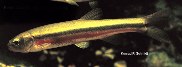
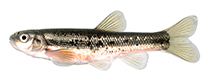
Margariscus margarita, Allegheny pearl dace : bait
> Cypriniformes (Carps) > Leuciscidae (Minnows) > Plagopterinae
Etymology: Margariscus:Greek, margariskos = pearl (Ref. 45335). Eponymy: These are not eponyms but relate to the meanings of ‘margarita’; pearl and daisy. The dragonfish was so-named due to having a “pearl-colored spot above the maxilla”. (Ref. 128868), visit book page. More on author: Cope.
Entorno: milieu / zona climática / rango de profundidad / gama de distribución Ecología
; agua dulce demersal; no migratorio (Ref. 126106). Temperate; 45°N - 37°N
North America: Atlantic Slope of USA from Hudson River drainage in Vermont and New York, south to Potomac River drainage in Virginia; upper Ohio River drainages in south New York to West Virginia (Ref. 86798); Canada from British Columbia to Newfoundland and Nova Scotia (Ref. 52559), Northwest Territories, and Yukon Territory (Ref. 119194).
Longitud en la primera madurez / Tamaño / Peso / Edad
Madurez: Lm9.4 range ? - ? cm Max length : 16.0 cm TL macho / no sexado; (Ref. 86798); common length : 9.3 cm TL macho / no sexado; (Ref. 12193); edad máxima reportada: 4 años (Ref. 12193)
Margariscus margarita is almost identical to Margariscus nachtriebi but can be distinguished from this species by having larger scales and usually 50-62 lateral scales (Ref. 86798). Body shape (shape guide): elongated.
Adults inhabit pools of upland creeks and small rivers, and also ponds and lakes. Usually found over sand or gravel (Ref. 86798). They feed on copepods, cladocerans, chironomids, beetles, filamentous algae, and Chara (Ref. 1998). Spawning occurs in spring (Ref. 1998).
Spawning occurs in shallow rivers with moderate current, on sand or gravel. Males maintained territories 20.3 cm wide (at least 1.83 m apart from each other). A ripe female is driven onto the territory. The male places his pectoral fin beneath the female's body anteriorly, and his caudal fin placed over the caudal peduncle of the female. The pair vibrates and the eggs are deposited. Females spawn with different males.
Page, L.M. and B.M. Burr, 2011. A field guide to freshwater fishes of North America north of Mexico. Boston : Houghton Mifflin Harcourt, 663p. (Ref. 86798)
Situación en la Lista Roja de la UICN (Ref. 130435: Version 2025-2 (Global))
Dinámica de la población Coeficiente del crecimiento para Edades / tallas máximas Longitud-peso rel. Longitud-longitud rel. Longitud-frecuencias Conversión de masas Reclutamiento Abundancia
Ciclo de vida Reproducción Madurez Madurez/Gills rel. Fecundidad Puesta Agregaciones de desove Huevos Desarrollo de los huevos Larva Dinámica larvaria
Fisiología Composición corporal Nutrientes Consumo del oxígeno Tipo de natación Velocidad de natación Pigmentos visuales Sonido de peces Enfermedades y parásitos Toxicidad (CL50)
Índice de diversidad filogenética (Referencia 82804): PD50 = 0.7500 [Uniqueness, from 0.5 = low to 2.0 = high].
Bayesian length-weight: a=0.00617 (0.00251 - 0.01514), b=3.05 (2.83 - 3.27), in cm total length, based on LWR estimates for this (Sub)family-body shape (Ref. 93245).
Nivel trófico (Referencia 69278): 3.1 ±0.36 se; based on food items.
Resiliencia (Referencia 120179): Medio, población duplicada en un tiempo mínimo de 1.4-4.4 años (tm=4).
Vulnerabilidad pesquera (Ref. 59153): Low vulnerability (10 of 100). 🛈