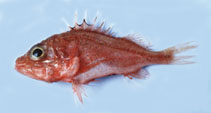
Environment: milieu / climate zone / rango de profundidad / distribution range
Ecología
marino batidemersal; rango de profundidad 180 - 704 m (Ref. 11015). Deep-water
Indo-West Pacific: Andaman Sea to Fiji; north to Japan; south to New Caledonia.
Tamaño / Peso / Age
Madurez: Lm ? range ? - ? cm
Max length : 18.0 cm SL macho / no sexado; (Ref. 559); peso máximo publicado: 58.00 g (Ref. 132231)
Espinas dorsales (total) : 11 - 13; Radios blandos dorsales (total) : 9 - 11; Espinas anales: 3; Radios blandos anales: 4 - 6. This species is distinguished by the following set of characters: scale rows between 6th dorsal-fn spine and lateral line 8-10 (usually 9); scale rows between last dorsal-fn spine and lateral line 10-13 (11); middle postorbital scale rows 3-4 (3); caudal-peduncle depth 8.2-9.6% (moderately 9.9%) of SL; interorbital width at vertical midline of eye 19.8-24.2% (22.3%) of HL, maxillary depth 14.3-16.9% (15.6%), and lower opercular spine length 28.0-33.6% (31.3%); dorsal margin of interorbital space is somewhat fattened; with nasal and parietal spines; supraocular spine is rudimentary; second lacrimal spine directed posteroventrally; tip of the lower opercular spine just short of or reaching to posterior margin of opercle (sometimes beyond margin in specimens from ca. 15.0 cm SL); jaws with short, dense conical teeth; premaxillary teeth in 3-6 irregular rows, totaling ca. 200 teeth. Colouration: head and body base color scarlet to dull red, with numerous small smudge-like or blurred black blotches above the lateral line when fresh; black distal margin on caudal fin in specimens from ca. > 10.0 cm SL; oral surface uniformly dull- to coal black in preserved specimens (uniformly pale, sometimes a few smudges on specimens up to ca. 10.0 cm SL) (Ref. 123746).
Body shape (shape guide): fusiform / normal; Cross section: compressed.
Found on the continental shelf and continental slope. Benthic (Ref. 75154). The dorsal spine contains poison glands which can inflict painful wounds (Ref. 11015).
Life cycle and mating behavior
Madurez | Reproducción | Puesta | Huevos | Fecundidad | Larva
Wada, H., Y. Kai and H. Motomura, 2021. Revision of the resurrected deep-water scorpionfish genus Lythrichthys Jordan and Starks 1904 (Setarchidae), with description of two new species. Ichthyol. Res. 68(3):373-403. (Ref. 123746)
IUCN Red List Status (Ref. 130435: Version 2025-1)
Threat to humans
Venomous
Human uses
Pesquerías: bycatch
Herramientas
Special reports
Download XML
Fuentes de Internet
Estimates based on models
Preferred temperature (Referencia
123201): 8.8 - 17.2, mean 11.8 °C (based on 290 cells).
Phylogenetic diversity index (Referencia
82804): PD
50 = 0.5317 [Uniqueness, from 0.5 = low to 2.0 = high].
Bayesian length-weight: a=0.01047 (0.00421 - 0.02606), b=3.04 (2.82 - 3.26), in cm total length, based on LWR estimates for this (Sub)family-body shape (Ref.
93245).
Nivel trófico (Referencia
69278): 3.3 ±0.4 se; based on size and trophs of closest relatives
Fishing Vulnerability (Ref.
59153): Low vulnerability (12 of 100).
🛈