>
Eupercaria/misc (Various families in series Eupercaria) >
Labridae (Wrasses)
Etymology: Lachnolaimus: Greek, lachne, -es = more covered with hair than other + Greek, laimos = throat (Ref. 45335).
More on author: Walbaum.
Environment: milieu / climate zone / تغييرات عمق / distribution range
بوم شناسي
دريايي وابسته به آب سنگ; تغييرات عمق 3 - 30 m (Ref. 9710). Subtropical; 46°N - 4°N, 98°W - 51°W
Western Atlantic: Nova Scotia (Canada), Bermuda, and northern Gulf of Mexico to northern South America.
Length at first maturity / Size / Weight / سن
بلوغ: Lm 18.1 range ? - ? cm
Max length : 91.0 cm TL جنس نر / بدون خواص جنسي; (Ref. 7251); common length : 35.0 cm TL جنس نر / بدون خواص جنسي; (Ref. 3726); بيشينه وزن گزارش شده: 11.0 kg (Ref. 36052); بيشينه سن گزارش شده: 23 سال ها (Ref. 93706)
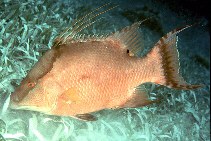
خارهاي باله پشتي (کل) : 14; شعاع نرم باله پشتي (کل) : 11; خارهاي باله مخرجي: 3; شعاع نرم باله مخرجي: 10. Deep-bodied wrasse with a strongly arched dorsal profile. First 3 dorsal spines filamentous. Only wrasse with elongate dorsal spines and such a highly arched profile (Ref. 26938). Color variable but generally mottled brownish red with a black spot at rear base of dorsal fin (Ref. 13442).
Body shape (shape guide): short and / or deep.
A large and economically valuable species, monandric and a protogynous hermaphrodite (Ref. 93709). Adults are found over open bottoms or coral reef areas (Ref. 5217). Often encountered where gorgonians are abundant (Ref. 13442). Feed mainly on mollusks, also crabs and sea urchins (Ref. 3726). Flesh highly esteemed; marketed fresh and frozen (Ref. 3726). Have been reared in captivity (Ref. 35420).
Monandric (no primary males) , protogynous hermaphrodites. Sex change is postmaturation; it is initiated among individuals 30-40 cm LF (or 3-5 yrs) but was also observed in fish as large as 69.4 cm LF (13 yrs). Sex change occurred after one more spawning (as a female) seasons and requires several months to complete (Ref.74380). Harem spawner (Ref.74381). Spawning activity is characterised by the following event called 'spawning rush': 1) pectoral swim up, 2) tail swim, 3) swin alongsode and tilt, 4) release, 5) circle and display, and 6) swim down (Ref. 74381).
Robins, C.R. and G.C. Ray, 1986. A field guide to Atlantic coast fishes of North America. Houghton Mifflin Company, Boston, U.S.A. 354 p. (Ref. 7251)
وضعيت در فهرست قرمز IUCN (Ref. 130435: Version 2025-1)
خطر برای انسان ها
Reports of ciguatera poisoning (Ref. 7251)
استفاده انسانی
ماهي گيري – شيلات: ارزش تحاري اندك; ماهي ها ي سرگرم كننده: بله; آكواريوم: تجاري
ابزارها
گزارش های ويژه
بارگيری XML
منابع اينترنتي
Estimates based on models
Preferred temperature (مرجع
123201): 23.7 - 28.2, mean 27.2 °C (based on 697 cells).
Phylogenetic diversity index (مرجع
82804): PD
50 = 1.0000 [Uniqueness, from 0.5 = low to 2.0 = high].
Bayesian length-weight: a=0.02188 (0.01338 - 0.03578), b=2.95 (2.80 - 3.10), in cm total length, based on LWR estimates for this species & (Sub)family-body (Ref.
93245).
Trophic level (مرجع
69278): 4.2 ±0.0 se; based on diet studies.
جهندگی (مرجع
120179): متوسط, كمينه زمان لازم براي دو برابر شدن جمعيت 4/1 – 4/4 سال (K=0.09; Fec=100,000; tm=1.1).
Prior r = 0.19, 95% CL = 0.13 - 0.29, Based on 2 full stock assessments.
Fishing Vulnerability (Ref.
59153): High vulnerability (59 of 100).
🛈
Nutrients (Ref.
124155): Calcium = 15.1 [6.5, 32.9] mg/100g; Iron = 0.409 [0.207, 0.871] mg/100g; Protein = 19.2 [16.3, 21.6] %; Omega3 = 0.139 [0.072, 0.268] g/100g; Selenium = 16.8 [6.0, 39.7] μg/100g; VitaminA = 33.2 [7.5, 187.3] μg/100g; Zinc = 0.578 [0.359, 0.973] mg/100g (wet weight);