Klassifizierung / Names
Namen | Synonyme | Catalog of Fishes(Gattung, Arten) | ITIS | CoL | WoRMS | Cloffa
Environment: milieu / climate zone / Tiefenbereich / distribution range
Ökologie
; süßwasser; brackwasser demersal. Subtropical; 12°C - 20°C (Ref. 2060); 52°N - 24°N, 99°W - 74°W
North America: Lake Erie and south Lake Michigan drainages south through Mississippi River basin to Gulf Slope drainages from lower Apalachicola River in Florida to Nueces River in Texas, USA.
Length at first maturity / Size / Gewicht / Alter
Geschlechtsreife: Lm ?, range 40 - ? cm
Max length : 150 cm TL Männchen/unbestimmt; (Ref. 57533); common length : 100.0 cm TL Männchen/unbestimmt; (Ref. 3728); max. veröff. Gewicht: 4.4 kg (Ref. 40637); max. veröff. Alter: 18 Jahre (Ref. 12193)
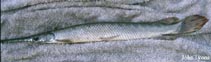
Profusion of dark spots on the body, head and fins. Dark in coloration (Ref. 37032).
Body shape (shape guide): elongated.
Facultative air-breathing (Ref. 126274); Adults occur in quiet, clear pools and backwaters of lowland creeks, small to large rivers, oxbow lakes, swamps and sloughs. Occasionally enter brackish waters. A voracious predator feeding on various kinds of fishes and crustaceans.
Robins, C.R., R.M. Bailey, C.E. Bond, J.R. Brooker, E.A. Lachner, R.N. Lea and W.B. Scott, 1991. Common and scientific names of fishes from the United States and Canada. Am. Fish. Soc. Spec. Publ. (20):183 p. (Ref. 3814)
IUCN Rote Liste Status (Ref. 130435: Version 2025-1)
Bedrohung für Menschen
Harmless
Nutzung durch Menschen
Fischereien: weniger kommerziell; Sportfisch: ja
Tools
Zusatzinformationen
Download XML
Internet Quellen
Estimates based on models
Phylogenetic diversity index (Ref.
82804): PD
50 = 0.5801 [Uniqueness, from 0.5 = low to 2.0 = high].
Bayesian length-weight: a=0.00269 (0.00115 - 0.00629), b=3.24 (3.04 - 3.44), in cm total length, based on LWR estimates for this species & (Sub)family-body (Ref.
93245).
Trophic level (Ref.
69278): 4.0 ±0.66 se; based on food items.
Widerstandsfähigkeit (Ref.
120179): mittel, Verdopplung der Population dauert 1,4 - 4,4 Jahre. (tm=4; Fec=1,772).
Fishing Vulnerability (Ref.
59153): Very high vulnerability (90 of 100).
🛈
Nutrients (Ref.
124155): Calcium = 37.9 [23.5, 80.5] mg/100g; Iron = 0.781 [0.471, 1.202] mg/100g; Protein = 18.6 [17.7, 19.5] %; Omega3 = 0.271 [0.161, 0.458] g/100g; Selenium = 45.8 [25.3, 84.3] μg/100g; VitaminA = 6.17 [2.51, 14.71] μg/100g; Zinc = 0.573 [0.426, 0.794] mg/100g (wet weight);