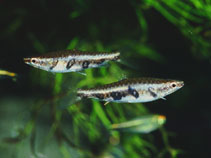
>
Characiformes (Characins) >
Lebiasinidae (Pencilfishes) > Pyrrhulininae
Etymology: Nannostomus: Latin, nannus = small + Greek, stoma = mouth (Ref. 45335).
Eponymy: Heinrich Espe was a dealer in ornamental fish. [...] (Ref. 128868), visit book page.
Issue
The most recent distributional records were published by Weitzman & Weitzman (1982: Fig. 229). Most recent systematic description by Weitzman (1966). Locality records including the locality of the original collections are discussed by Weitzman & Cobb (1975). Lectotype designated by Weitzman (1966). Occasionally exported as an aquarium fish, Weitzman et al. (2001) and Bork & Mayland (1998).
Environment: milieu / climate zone / profondeur / distribution range
Écologie
; eau douce benthopélagique; pH range: 5.5 - 7.0; dH range: 4 - 10. Tropical; 22°C - 26°C (Ref. 1672)
South America: Mazaruni River system, Guyana.
Taille / Poids / Âge
Maturité: Lm ? range ? - ? cm
Max length : 4.0 cm TL mâle / non sexé; (Ref. 41850); common length : 2.8 cm SL mâle / non sexé; (Ref. 37401)
Feeds on worms, crustaceans and insects (Ref. 7020).
Life cycle and mating behavior
Maturité | Reproduction | Frai | Œufs | Fécondité | Larves
During courtship males swim above females, and nudge them on the head. Males attach 20-40 eggs to the underside of leaves, using their bag-like anal fin.
Weitzman, M. and S.H. Weitzman, 2003. Lebiasinidae (Pencil fishes). p. 241-251. In R.E. Reis, S.O. Kullander and C.J. Ferraris, Jr. (eds.) Checklist of the Freshwater Fishes of South and Central America. Porto Alegre: EDIPUCRS, Brasil. (Ref. 37104)
Statut dans la liste rouge de l'IUCN (Ref. 130435: Version 2025-1)
Menace pour l'homme
Harmless
Utilisations par l'homme
Pêcheries: sans intérêt; Aquarium: Commercial
Outils
Articles particuliers
Télécharger en XML
Sources Internet
Estimates based on models
Phylogenetic diversity index (Réf.
82804): PD
50 = 0.5000 [Uniqueness, from 0.5 = low to 2.0 = high].
Bayesian length-weight: a=0.00631 (0.00270 - 0.01474), b=3.08 (2.88 - 3.28), in cm total length, based on LWR estimates for this (Sub)family-body shape (Ref.
93245).
Niveau trophique (Réf.
69278): 3.3 ±0.40 se; based on food items.
Résilience (Réf.
120179): Haut, temps minimum de doublement de population inférieur à 15 mois (tm=0.5-58, Fec=50-70).
Fishing Vulnerability (Ref.
59153): Low vulnerability (10 of 100).
🛈