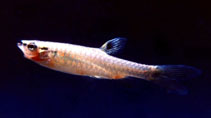
Pyrrhulina laeta, Halfbanded pyrrhulina : fisheries, aquarium

You can sponsor this page

Pyrrhulina laeta (Cope, 1872)

Halfbanded pyrrhulina
Upload your photos and videos
Bilder | Google image
Image of Pyrrhulina laeta (Halfbanded pyrrhulina)
Pyrrhulina laeta
Picture by Landines, M.

Classification / Names Populärnamn | synonymer | Catalog of Fishes(Släkte, Arter) | ITIS | CoL | WoRMS | Cloffa

> Characiformes (Characins) > Lebiasinidae (Pencilfishes) > Pyrrhulininae
Etymology: Pyrrhulina: Greek, pyrrhos = red, with the colour of the fire (Ref. 45335).
More on author: Cope.

Issue
Illustrated by Fowler, 1906 already without its head, the unique holotype has no head, fins, or scales, thus certain identity is difficult. However, it is confused with other species in the literature and its identity needs to be clarified. Marilyn Weitzman, pers. comm. Eschmeyer, 1998: 862; Ortega and Vari, 1986: 11.

Environment: milieu / climate zone / djupintervall / distribution range Ekologi

; sötvatten bentopelagisk; pH range: 5.8 - 7.0; dH range: 2 - 8. Tropical; 23°C - 27°C (Ref. 2060)

Utbredning Länder | FAO områden | Ekosystem | Förekomster | Prickkarta | Utplanteringar | Faunafri

South America: presumed to be central and upper Amazon River Basin.

Size / Vikt / Age

Könsmognad: Lm ?  range ? - ? cm
Max length : 7.6 cm SL hane/ej könsbestämd; (Ref. 37104)

Biologi     Ordlista (t.ex. epibenthic)

Feeds on worms, crustaceans and insects (Ref. 7020).

Life cycle and mating behavior Könsmognad | Reproduktion | Lek | Ägg | Fecundity | Larver

Main reference Upload your references | referenser | Koordinator : Weitzman, Marilyn | Medarbetare

Weitzman, M. and S.H. Weitzman, 2003. Lebiasinidae (Pencil fishes). p. 241-251. In R.E. Reis, S.O. Kullander and C.J. Ferraris, Jr. (eds.) Checklist of the Freshwater Fishes of South and Central America. Porto Alegre: EDIPUCRS, Brasil. (Ref. 37104)

IUCN Red List Status (Ref. 130435: Version 2025-1)

  Least Concern (LC) ; Date assessed: 03 November 2020

CITES

Not Evaluated

CMS (Ref. 116361)

Not Evaluated

Threat to humans

  Harmless


Human uses

Fiskeri: kommersiell; Akvarium: Kommersiell
FAO - Publication: search | FishSource |

Ytterligare information

Trophic ecology
Food items (preys)
Födosammansättning
Födointag
Food rations
Predatorer
Ekologi
Ekologi
Home ranges
Population dynamics
Tillväxtparametrar
Max. ages / sizes
Length-weight rel.
Length-length rel.
Length-frequencies
Mass conversion
Rekrytering
Abundans
Life cycle
Reproduktion
Könsmognad
Maturity/Gills rel.
Fecundity
Lek
Spawning aggregations
Ägg
Egg development
Larver
Larvdynamik
Anatomy
Gälyta
Brain
Otolith
Physiology
Body composition
Nutrients
Syreförbrukning
Swimming type
Simhastighet
Visual pigments
Fish sound
Diseases & Parasites
Toxicity (LC50s)
Genetik
Genome
Genetik
Heterozygosity
Ärftlighet
Human related
Aquaculture systems
Vattenbruksprofiler
Avelslinjer
Ciguatera cases
Stamps, coins, misc.
Outreach
Medarbetare
referenser
referenser

Verktyg

Special reports

Download XML

Internet-källor

AFORO (otoliths) | Aquatic Commons | BHL | Cloffa | Websites from users | Check FishWatcher | CISTI | Catalog of Fishes: Släkte, Arter | DiscoverLife | ECOTOX | FAO - Publication: search | Faunafri | Fishipedia | Fishtrace | GloBI | Google Books | Google Scholar | Google | IGFA World Record | OneZoom | Open Tree of Life | Otolith Atlas of Taiwan Fishes | PubMed | Reef Life Survey | Socotra Atlas | TreeBase | Tree of Life | Wikipedia: Go, sök | Zoological Record

Estimates based on models

Phylogenetic diversity index (Ref. 82804):  PD50 = 0.5000   [Uniqueness, from 0.5 = low to 2.0 = high].
Bayesian length-weight: a=0.00631 (0.00270 - 0.01474), b=3.08 (2.88 - 3.28), in cm total length, based on LWR estimates for this (Sub)family-body shape (Ref. 93245).
Trofisk nivå (Ref. 69278):  3.3   ±0.40 se; based on food items.
Fishing Vulnerability (Ref. 59153):  Low vulnerability (10 of 100). 🛈
Price category (Ref. 80766):   Unknown.