



Adicionar o seu Fotografias e vídeos
Imagem do Google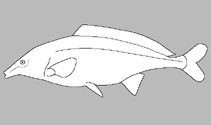 No image available for this species;
drawing shows typical species in Mormyridae.
Imagem do Google
drawing shows typical species in Mormyridae.
Classificação / Nomes Nomes comuns | Sinónimos | Catalog of Fishes(Género, Espécies) | ITIS | CoL | WoRMS | Cloffa
> Osteoglossiformes (Bony tongues) > Mormyridae (Elephantfishes)
Etymology: Paramormyrops: Greek, para = near + Greek, mormyros = a fish (Sparus sp) (Ref. 45335); sphekodes: The name sphekodes comes from the Greek, σφήκα, for wasp, which may refer to the fish's elongate and slender body (Ref. 116799).
More on author: Sauvage.
Etymology: Paramormyrops: Greek, para = near + Greek, mormyros = a fish (Sparus sp) (Ref. 45335); sphekodes: The name sphekodes comes from the Greek, σφήκα, for wasp, which may refer to the fish's elongate and slender body (Ref. 116799).
More on author: Sauvage.
Ambiente: milieu / zona climática / intervalo de profundidade / gama de distribuição Ecologia
; Água doce bentopelágico. Tropical
Distribuição Territórios | Áreas FAO | Ecossistemas | Ocorrências | Mapa dos pontos | Introduções | Faunafri
Africa: Ogowe River and other coastal river basins in Cameroon, Gabon and Republic of Congo (Ref. 81635). Possibly a narrowly distributed species, endemic to a relatively small part of the upper Ogowe River basin (Ref. 116799). Reports from the Congo River basin (Ref. 1878, 3203, 51193, 88779, 120641) unconfirmed in other sources (Ref. 81635, 116799).
Tamanho / Peso / Idade
Descrição breve Chaves de identificação | Morfologia | Morfometria
Espinhos dorsais (total) : 0; Raios dorsais moles (total) : 20 - 23; Espinhos anais: 0; Raios anais moles: 24 - 28; Vértebras: 43 - 45. Diagnosis: Paramormyrops sphekodes is distinguished from all other Paramormyrops by this combination of characters: 5 teeth in upper jaw, 6 in lower; 12 circumpeduncular scales; sharp head profile, V-shaped when viewed from above; snout angle 48-56° corresponding to an interorbital width 1-1.36 times the snout length; body depth 15.4-17.31% of standard length, body depth at pectoral fin 84-94% of body depth at urogenital pore; eye diameter 13-16% of head length measured from snout tip to posterior edge of bony operculum; snout length 24-27% of head length; ration of head length to depth 1.1-1.24; head length 21-23% of standard length; EOD waveform with two phases, head-positive then negative, EOD duration 1.635 ± 0.226 ms with a corresponding power spectrum peak at 1573 ± 531 Hz; electric organ composed of type NPp electrocytes, that is having Non-Penetrating stalks innervated on the posterior face of the cell (Ref. 116799). With five teeth in the upper jaw and six in the lower, P. sphekodes differs from P. hopkinsi, P. jacksoni and P. tavernei, which have seven or more teeth in the upper jaw and eight or more in the lower jaw; with 12 circumpeduncular scales, it differs from P. longicaudatus, P. batesii and P. tavernei, which all have 16 or more; with its relatively sharp V-shaped head profile, it differs from P. batesii, P. gabonensis, P. retrodorsalis, P. tavernei and P. kingsleyae which have distinctly blunt or U-shaped snouts; Paramormyrops sphekodes has type NPp electrocytes in its electric organ, as do seven other Paramormyrops from Lower Guinea, while P. batesii and P. kingsleyae have electric organs composed of electrocytes with penetrating stalks innervated on the anterior face (Ref. 116799). Paramormyrops sphekodes differs from P. curvifrons in head and snout shape; head and snout are shorter, deeper and more rounded when viewed laterally in P. sphekodes compared to P. curvifrons; Paramormyrops curvifrons also has a downward sloping forehead, protruding snout and enlarged chin; the ratio head length to standard length is 23.5-26.9 in P. curvifrons, higher than 21.5-23.4 in P. sphekodes, while the ratio of head depth to head length is reduced in P. curvifrons compared to P. sphekodes; the ratio of pre-pectoral distance to pre-dorsal distance is greater in P. curvifrons compared to P. sphekodes, and P. curvifrons has a significantly narrower snout than P. sphekodes measured by either snout angle or ratio interorbital width to snout length (Ref. 116799).
Body shape (shape guide): fusiform / normal.
Body shape (shape guide): fusiform / normal.
Found in large river habitats with rocky bottoms, sandy substrate, with rushing water and rapids (Ref. 116799).
Ciclo de vida e comportamento de acasalamento Maturidade | Reprodução | Desova | Ovos | Fecundidade | Larvas
Referência principal
Carregar as suas referências | Referências | Coordenador | Colaboradores
Hopkins, C.D., S. Lavoué and J.P. Sullivan, 2007. Mormyridae. p. 219-334. In M.L.J. Stiassny, G.G. Teugels and C.D. Hopkins (eds.) The fresh and brackish water fishes of Lower Guinea, West-Central Africa. Volume I. Collection Faune et Flore tropicales 42. Institut de Recherche pour le Développement, Paris, France, Muséum National d’Histoire Naturelle, Paris, France, and Musée Royal de l’Afrique Centrale, Tervuren, Belgium. 800 pp. (Ref. 81635)
Categoria na Lista Vermelha da IUCN (Ref. 130435: Version 2025-2 (Global))
Preocupação menor (LC) ; Date assessed: 16 February 2009
CITES
Not Evaluated
Ameaça para o homem
Harmless
Utilização humana
FAO - Publication: search | FishSource |
Mais informação
Ecologia Trófica
Produtos alimentares (presas)
Composição da dieta
Consumo alimentar
Rações alimentares
Predadores
Produtos alimentares (presas)
Composição da dieta
Consumo alimentar
Rações alimentares
Predadores
Dinâmica das populações
Parâmetros de crescimento
Idades / tamanhos máximos
Comprimento-peso rel.
Comprimento-comprimento rel.
Frequência de comprimento
Conversão de massa
Recrutamento
Abundância
Parâmetros de crescimento
Idades / tamanhos máximos
Comprimento-peso rel.
Comprimento-comprimento rel.
Frequência de comprimento
Conversão de massa
Recrutamento
Abundância
Ciclo de vida
Reprodução
Maturidade
Maturidade/Rel. das guelras
Fecundidade
Desova
Agregações de desova
Ovos
Desenvolvimento dos ovos
Larvas
Dinâmica larvar
Reprodução
Maturidade
Maturidade/Rel. das guelras
Fecundidade
Desova
Agregações de desova
Ovos
Desenvolvimento dos ovos
Larvas
Dinâmica larvar
Anatomia
Área branquial
Cérebro
Otólitos
Área branquial
Cérebro
Otólitos
Fisiologia
Composição corporal
Nutrientes
Consumo de oxigénio
Tipo de natação
Velocidade de natação
Pigmentos visuais
Som de peixe
Doenças e Parasitas
Toxicidade (LC50s)
Composição corporal
Nutrientes
Consumo de oxigénio
Tipo de natação
Velocidade de natação
Pigmentos visuais
Som de peixe
Doenças e Parasitas
Toxicidade (LC50s)
Genética
genoma
Genética
Heterozigotia
Hereditariedade
Diversidade genética
genoma
Genética
Heterozigotia
Hereditariedade
Diversidade genética
Relacionado com o ser humano
Sistemas de aquacultura
Perfis para aquacultura
Estirpes
Casos de Ciguatera
Selos, moedas, diversos.
Sistemas de aquacultura
Perfis para aquacultura
Estirpes
Casos de Ciguatera
Selos, moedas, diversos.
Ferramentas
E-book | Guia de campo | Chaves de identificação | Ferramenta auxiliar de frequências de comprimento | Ferramenta sobre a história de vida | Mapa dos pontos |
Captura-MSY |
Relatórios especiais
Descarregue XML
Fontes da internet
AFORO (otoliths) | Aquatic Commons | BHL | Cloffa | Websites from users | Consultar FishWatcher | CISTI | Catalog of Fishes: Género, Espécies | DiscoverLife | ECOTOX | FAO - Publication: search | Faunafri | Fishipedia | Fishtrace | GloBI | Google Books | Google Scholar | Google | IGFA World Record | OneZoom | Open Tree of Life | Otolith Atlas of Taiwan Fishes | PubMed | Reef Life Survey | Socotra Atlas | TreeBase | Árvore da vida | Wikipedia: ir para, procurar | World Records Freshwater Fishing | Registo zoológico
Estimativas baseadas em modelos
Índice de diversidade filogenética (Ref. 82804): PD50 = 0.5010 [Uniqueness, from 0.5 = low to 2.0 = high].
Bayesian length-weight: a=0.01259 (0.00585 - 0.02711), b=2.87 (2.69 - 3.05), in cm total length, based on LWR estimates for this (Sub)family-body shape (Ref. 93245).
Nível Trófico (Ref. 69278): 3.1 ±0.3 se; based on size and trophs of closest relatives
Resiliência (Ref. 120179): Médio, tempo mínimo de duplicação da população 1,4 - 4,4 anos (Assuming Fec < 5,000).