Klassifizierung / Names
Namen | Synonyme | Catalog of Fishes(Gattung, Arten) | ITIS | CoL | WoRMS | Cloffa
Environment: milieu / climate zone / Tiefenbereich / distribution range
Ökologie
; süßwasser benthopelagisch; pH range: 6.0 - 7.5; dH range: ? - 15; potamodrom (Ref. 51243). Subtropical; 22°C - 28°C (Ref. 1672)
Central and South America: southern Mexico to Paraguay, including Trinidad.
Length at first maturity / Size / Gewicht / Alter
Geschlechtsreife: Lm 19.4, range 25 - ? cm
Max length : 76.0 cm TL Männchen/unbestimmt; (Ref. 79585); max. veröff. Gewicht: 1.2 kg (Ref. 79585)
Kurzbeschreibung
Bestimmungsschlüssel | Morphologie | Morphometrie
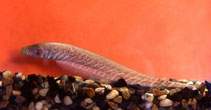
Facultative air-breathing (Ref. 126274); Aggressive (Ref. 27188). Inhabits turbid slow moving or standing waters (Ref. 11225). Found also in shallow edges of streams (Ref. 75964). Can survive when ditches, canals and small ponds dry out. (Ref. 11225). Feeds mainly at night on worms, insects (e.g. odonate larvae), shrimps, fish (preferably small characids, e.g. Ctenobrycon and Curimata) and plant matter (Ref. 7020; 10011). Oviparous (Ref. 205). Mouth brooding by males is observed in this species (Ref. 55570). Males provide parental care in nests excavated for eggs and larvae (Ref. 55570). Uses its long anal fin for locomotion. Can distinguish between a `friendly neighbor' and a potentially `threatening stranger' based on electric organ discharge (EOD) waveform alone (Ref. 10011). Relationship between EOD pattern and agonistic behavior in this species has been demonstrated (Refs. 10531, 10532, 10533). Shows auditory abilities, responding best to a frequency of 1000 Hz, with an upper limit above 5000 Hz (Ref. 10831). Also responds to vibratory stimuli (water waves: 125-250 Hz) with transient increase in EOD rate (Ref. 10834). 'Prefers' temperatures of 24-25°C (Ref. 10836).
Parental care is provided by the male. The male sits on a depression with its anal fin expanded horizontally guarding a cluster of larvae. More larvae are spread out in leaf litter up to 2 m away (Ref. 55570).
Campos-da-Paz, R., 2003. Gymnotidae (Naked-back knifefishes). p. 483-486. In R.E. Reis, S.O. Kullander and C.J. Ferraris, Jr. (eds.) Checklist of the Freshwater Fishes of South and Central America. Porto Alegre EDIPUCRS, Brasil. (Ref. 36692)
IUCN Rote Liste Status (Ref. 130435: Version 2025-1)
Bedrohung für Menschen
Harmless
Nutzung durch Menschen
Fischereien: nicht kommerziell; Aquarium: Kommerziell
Tools
Zusatzinformationen
Download XML
Internet Quellen
Estimates based on models
Phylogenetic diversity index (Ref.
82804): PD
50 = 0.5000 [Uniqueness, from 0.5 = low to 2.0 = high].
Bayesian length-weight: a=0.00372 (0.00286 - 0.00483), b=2.93 (2.85 - 3.01), in cm total length, based on LWR estimates for this species (Ref.
93245).
Trophic level (Ref.
69278): 3.6 ±0.56 se; based on food items.
Generation time: 3.6 ( na - na) years. Estimated as median ln(3)/K based on 2
growth studies.
Widerstandsfähigkeit (Ref.
120179): mittel, Verdopplung der Population dauert 1,4 - 4,4 Jahre. (tm=2).
Fishing Vulnerability (Ref.
59153): Moderate vulnerability (37 of 100).
🛈
Nutrients (Ref.
124155): Calcium = 51.3 [21.6, 112.8] mg/100g; Iron = 0.975 [0.510, 1.782] mg/100g; Protein = 18.3 [17.1, 19.6] %; Omega3 = 0.33 [0.13, 0.83] g/100g; Selenium = 25.6 [9.8, 63.4] μg/100g; VitaminA = 21.8 [6.9, 67.1] μg/100g; Zinc = 1 [1, 1] mg/100g (wet weight);