



Upload your photos and videos
Google image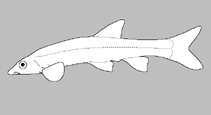 No image available for this species;
drawing shows typical species in Kneriidae.
Google image
drawing shows typical species in Kneriidae.
Classification / Names Common names | Synonyms | Catalog of Fishes(genus, species) | ITIS | CoL | WoRMS | Cloffa
Teleostei (teleosts) > Gonorynchiformes (Milkfishes) > Kneriidae (Shellears)
Etymology: Kneria: From Kner, that studied fishes in the Imperial Museum of Vienna, with Jean Natterer (1817) (Ref. 45335).
Eponymy: Dr Rudolf Kner (1810–1869) was an Austrian zoologist specialising in ichthyology. [...] This is a toponym; the holoypes of these fishes were collected in Katanga Province (formerly part of the Belgian Congo, now the Democratic Republic of Congo). (Ref. 128868), visit book page.
More on author: Poll.
Etymology: Kneria: From Kner, that studied fishes in the Imperial Museum of Vienna, with Jean Natterer (1817) (Ref. 45335).
Eponymy: Dr Rudolf Kner (1810–1869) was an Austrian zoologist specialising in ichthyology. [...] This is a toponym; the holoypes of these fishes were collected in Katanga Province (formerly part of the Belgian Congo, now the Democratic Republic of Congo). (Ref. 128868), visit book page.
More on author: Poll.
Environment: milieu / climate zone / depth range / distribution range Ecology
Freshwater; benthopelagic. Tropical
Distribution Territories | FAO areas | Ecosystems | Occurrences | Point map | Introductions | Faunafri
Africa: Munte River system (Lufira River tributary, upper Lualaba drainage) in Democratic Republic of the Congo (Ref. 2970, 45434).
Size / Weight / Age
Short description Identification keys | Morphology | Morphometrics
Dorsal spines (total): 0; Dorsal soft rays (total): 11; Anal spines: 0; Anal soft rays: 10; Vertebrae: 41. Diagnosis: body depth 18-23.2% of standard length (SL); head length 20.3-24.3% SL; snout rounded, wider than long, 26.1-31.5% head length, 94.4-104.3% eye diameter (ED); eye diameter 26.1-30.2% head length; interorbital distance 100-117.4% ED; preorbital distance 38.9-47.8% ED; mouth ventral, wide; lower lip with weakly developed cutting edge; opercular apparatus (only well dveloped in males) consisting of an opercular suction disc followed by a striated, moderately developed postopercular part with about 12 ridges; dorsal and anal fins with 3 unbranched rays; dorsal fin positioned about 0.9-1.1 times closer to tip of snout than to caudal fin origin, inserted at about the same level as pelvic fins; anal fin about halfway pelvic fins and caudal fin origin; pectoral and pelvic fins with a single unbranched ray; pectoral fin 17.3-19.7% SL; body yellowish, dorsal surfaces darker, brownish; dark lateral band not very distinct (Ref. 2970).
Remark: note that the first column in the comparative table in Ref. 2970 (p. 41) contains the morphometrics for K. katangae and the second for K. paucisquamata, contrarily to what is mentioned above the respective columns (T. Musschoot, pers. comm.).
Body shape (shape guide): elongated; Cross section: circular.
Body shape (shape guide): elongated; Cross section: circular.
Maximum TL was recorded at 5.5 cm (Ref. 2970).
Life cycle and mating behavior Maturity | Reproduction | Spawning | Eggs | Fecundity | Larvae
Main reference
Upload your references | References | Coordinator | Collaborators
Poll, M., 1984. Kneriidae. p. 129-133. In J. Daget, J.-P. Gosse and D.F.E. Thys van den Audenaerde (eds.) Check-list of the freshwater fishes of Africa (CLOFFA). ORSTOM, Paris and MRAC, Tervuren. Vol. 1. (Ref. 3565)
IUCN Red List Status (Ref. 130435: Version 2025-2 (Global))
Least Concern (LC) ; Date assessed: 16 February 2009
CITES
Not Evaluated
Threat to humans
Harmless
Human uses
FAO - Publication: search | FishSource |
More information
Trophic ecology
Food items (preys)
Diet composition
Food consumption
Food rations
Predators
Food items (preys)
Diet composition
Food consumption
Food rations
Predators
Ecology
Ecology
Ecology
Population dynamics
Growth parameters
Max. ages / sizes
Length-weight rel.
Length-length rel.
Length-frequencies
Mass conversion
Recruitment
Abundance
Growth parameters
Max. ages / sizes
Length-weight rel.
Length-length rel.
Length-frequencies
Mass conversion
Recruitment
Abundance
Life cycle
Reproduction
Maturity
Maturity/Gills rel.
Fecundity
Spawning
Spawning aggregations
Eggs
Egg development
Larvae
Larval dynamics
Reproduction
Maturity
Maturity/Gills rel.
Fecundity
Spawning
Spawning aggregations
Eggs
Egg development
Larvae
Larval dynamics
Anatomy
Gill area
Brain
Otolith
Gill area
Brain
Otolith
Physiology
Body composition
Nutrients
Oxygen consumption
Swimming type
Swimming speed
Visual pigments
Fish sound
Diseases & Parasites
Toxicity (LC50s)
Body composition
Nutrients
Oxygen consumption
Swimming type
Swimming speed
Visual pigments
Fish sound
Diseases & Parasites
Toxicity (LC50s)
Genetics
Genome
Genetics
Heterozygosity
Heritability
Genetic Diversity
Genome
Genetics
Heterozygosity
Heritability
Genetic Diversity
Human related
Aquaculture systems
Aquaculture profiles
Strains
Ciguatera cases
Stamps, coins, misc.
Aquaculture systems
Aquaculture profiles
Strains
Ciguatera cases
Stamps, coins, misc.
Tools
Special reports
Download XML
Internet sources
AFORO (otoliths) | Aquatic Commons | BHL | Cloffa | Websites from users | Check FishWatcher | CISTI | Catalog of Fishes: genus, species | DiscoverLife | ECOTOX | FAO - Publication: search | Faunafri | Fishipedia | Fishtrace | GloBI | Google Books | Google Scholar | Google | IGFA World Record | OneZoom | Open Tree of Life | Otolith Atlas of Taiwan Fishes | PubMed | Reef Life Survey | Socotra Atlas | TreeBase | Tree of Life | Wikipedia: Go, Search | World Records Freshwater Fishing | Zoobank | Zoological Record