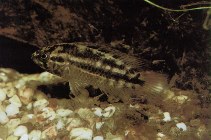
Nannacara anomala, Goldeneye cichlid : fisheries, aquarium

You can sponsor this page

Nannacara anomala Regan, 1905

Goldeneye cichlid
Envoyez vos Photos et vidéos
Images | vidéos | Images Google
Image of Nannacara anomala (Goldeneye cichlid)
Nannacara anomala
Female Photo de DATZ

Classification / Names Noms communs | Synonymes | Catalog of Fishes(Genre, Espèce) | ITIS | CoL | WoRMS | Cloffa

> Cichliformes (Cichlids, convict blennies) > Cichlidae (Cichlids) > Cichlinae
Etymology: Nannacara: Latin, nannus = small + Greek, kara = face (Ref. 45335).
More on author: Regan.

Issue
Redescribed in Kullander & Nijssen (1989: 199), based on Surinamese material, with bibliography, diagnosis, description, distribution, and illustrations.

Environment: milieu / climate zone / profondeur / distribution range Écologie

; eau douce benthopélagique; pH range: 6.0 - 8.0; dH range: 5 - 19. Tropical; 22°C - 25°C (Ref. 1672)

Distribution Pays | Zones FAO | Écosystèmes | Occurrences | Carte par point | Introductions | Faunafri

South America: Aruka River in Guyana east to the lower Marowijne River in Suriname.

Taille / Poids / Âge

Maturité: Lm ?  range ? - ? cm
Max length : 5.6 cm SL mâle / non sexé; (Ref. 36377)

Biologie     Glossaire (ex. epibenthic)

Frequently occurs in flooded savannas of the coastal zone (Ref. 27188). Feeds on worms, crustaceans and insects (Ref. 7020). Quite popular among aquarists who breed it without difficulty. Males are larger and more colorful, possessing more distinctly more elongated unpaired fins (Ref. 35237). Aquarium keeping: several females for one male; minimum aquarium size 80 cm (Ref. 51539).

Life cycle and mating behavior Maturité | Reproduction | Frai | Œufs | Fécondité | Larves

During spawning the female changes its color to a chess-board pattern, which is apparently recognized by the young. Only the female takes care of the (up to 300) eggs and young, the male may defend the larger territory (Ref. 40602).

Référence principale Upload your references | Références | Coordinateur : Kullander, Sven O. | Collaborateurs

Kullander, S.O. and H. Nijssen, 1989. The cichlids of Surinam: Teleostei, Labroidei. E.J. Brill, Leiden, The Netherlands. 256 p. (Ref. 26372)

Statut dans la liste rouge de l'IUCN (Ref. 130435: Version 2025-1)

  Préoccupation mineure (LC) ; Date assessed: 12 March 2023

CITES

Not Evaluated

CMS (Ref. 116361)

Not Evaluated

Menace pour l'homme

  Harmless


Utilisations par l'homme

Pêcheries: commercial; Aquarium: Commercial
FAO - Publication: search | FishSource |

Plus d'informations

Écologie trophique
Food items (preys)
Composition du régime alimentaire
Consommation alimentaire
Food rations
Prédateurs
Écologie
Écologie
Home ranges
Population dynamics
Paramètres de croissance
Max. ages / sizes
Length-weight rel.
Length-length rel.
Fréquences de longueurs
Mass conversion
Recrutement
Abondance
Life cycle
Reproduction
Maturité
Maturity/Gills rel.
Fécondité
Frai
Spawning aggregations
Œufs
Développement de l'œuf
Larves
Dynamique des populations larvaires
Distribution
Pays
Zones FAO
Écosystèmes
Occurrences
Introductions
BRUVS - Videos
Anatomy
Surface branchiale
Brain
Otolith
Physiology
Body composition
Nutrients
Consommation d'oxygène
Type de nage
Vitesse de nage
Visual pigments
Fish sound
Diseases & Parasites
Toxicity (LC50s)
Génétique
génôme
Génétique
Heterozygosity
Héritabilité
Human related
Aquaculture systems
Profils d'aquaculture
Souches
Ciguatera cases
Stamps, coins, misc.
Outreach
Collaborateurs
Références
Références

Outils

Articles particuliers

Télécharger en XML

Sources Internet

AFORO (otoliths) | Aquatic Commons | BHL | Cloffa | Websites from users | FishWatcher | CISTI | Catalog of Fishes: Genre, Espèce | DiscoverLife | ECOTOX | FAO - Publication: search | Faunafri | Fishipedia | Fishtrace | GloBI | Google Books | Google Scholar | Google | IGFA World Record | OneZoom | Open Tree of Life | Otolith Atlas of Taiwan Fishes | PubMed | Reef Life Survey | Socotra Atlas | TreeBase | Arbre de Vie | Wikipedia: aller à, chercher | Zoobank | Zoological Record

Estimates based on models

Phylogenetic diversity index (Réf. 82804):  PD50 = 0.5156   [Uniqueness, from 0.5 = low to 2.0 = high].
Bayesian length-weight: a=0.01380 (0.00659 - 0.02894), b=3.07 (2.89 - 3.25), in cm total length, based on LWR estimates for this (Sub)family-body shape (Ref. 93245).
Niveau trophique (Réf. 69278):  3.3   ±0.40 se; based on food items.
Résilience (Réf. 120179):  Haut, temps minimum de doublement de population inférieur à 15 mois (tm<1).
Fishing Vulnerability (Ref. 59153):  Low vulnerability (10 of 100). 🛈
Catégorie de prix (Ref. 80766):   Unknown.