



Distichodus langi Nichols & Griscom, 1917
Adicionar o seu Fotografias e vídeos
Imagem do Google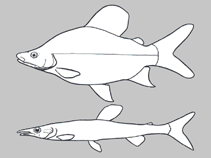 No image available for this species;
drawing shows typical species in Distichodontidae.
Imagem do Google
drawing shows typical species in Distichodontidae.
Classificação / Nomes Nomes comuns | Sinónimos | Catalog of Fishes(Género, Espécies) | ITIS | CoL | WoRMS | Cloffa
> Characiformes (Characins) > Distichodontidae (Distichodus)
Etymology: Distichodus: Greek, di = two + Greek, stix, stichos = line, row (Ref. 45335); langi: Named in honour of the collector, Herbert Lang (Ref. 41594), who collected fish in the Congo basin from 1909 to 1915 for the AMNH, in collaboration with James Chapin (Ref. 96324).
Eponymy: Herbert Otto Henry Lang (1879–1957) was born in Germany and trained as a taxidermist. [...] (Ref. 128868), visit book page.
More on authors: Nichols & Griscom.
Etymology: Distichodus: Greek, di = two + Greek, stix, stichos = line, row (Ref. 45335); langi: Named in honour of the collector, Herbert Lang (Ref. 41594), who collected fish in the Congo basin from 1909 to 1915 for the AMNH, in collaboration with James Chapin (Ref. 96324).
Eponymy: Herbert Otto Henry Lang (1879–1957) was born in Germany and trained as a taxidermist. [...] (Ref. 128868), visit book page.
More on authors: Nichols & Griscom.
Ambiente: milieu / zona climática / intervalo de profundidade / gama de distribuição Ecologia
; Água doce pelágico(a,os,as). Tropical
Distribuição Territórios | Áreas FAO | Ecossistemas | Ocorrências | Mapa dos pontos | Introduções | Faunafri
Africa: Uele River in Democratic Republic of the Congo (Ref. 41594, 96324). Also reported from Aruwimi River (Ref. 96324), but this is unconfirmed (Ref. 106290).
Tamanho / Peso / Idade
Descrição breve Chaves de identificação | Morfologia | Morfometria
Espinhos dorsais (total) : 0; Raios dorsais moles (total) : 26 - 28; Espinhos anais: 0; Raios anais moles: 14. Diagnosis: Within the Congo basin, Distichodus langi can be distinguished from D. affinis, D. altus, D. decemmaculatus, D. noboli, D. notospilus and D. teugelsi by its higher total number of lateral line scales, 68-70 vs. less than 46; from D. maculatus by the absence of large, dark spots all over the body and a higher number of dorsal fin rays, 26-28 vs. 19-21; from D. antonii by its inferior, vs. terminal, mouth, its higher number of scales between the lateral line and the dorsal fin, 15-16 vs. 10-12, and its higher number of lateral line scales in front of the hypural joint, 68-70 vs. 52-64; from D. fasciolatus by its higher number of dorsal fin rays, 26-28 vs. 24-26, its higher number of pelvic fin rays, 11 vs. generally 10, and its deeper head, 67.4-69.4% of head length vs. 35.9-62.9% of head length; from D. lusosso by its inferior, vs. terminal, mouth and feebly compressed snout, vs. distinctive prolonged; from D. sexfasciatus by its feebly compressed snout, vs. strongly compressed, its higher number of dark vertical bars along the body, 13 vs. 6-7, and its higher number of teeth on the outer row on both jaws, more than 20 vs. 12-14; and from the D. atroventralis complex by a higher number of scales between the lateral line and pelvic fin, 12 vs. 9-11, its higher number of pectoral fin rays, 21 vs. 17-20, its higher number of circumpeduncular scales, 24-25 vs. 20-24, and its deeper head, 67.4-69.4% of head length vs. 35.1-55.7% of head length (Ref. 96324).
Body shape (shape guide): short and / or deep.
Body shape (shape guide): short and / or deep.
Ciclo de vida e comportamento de acasalamento Maturidade | Reprodução | Desova | Ovos | Fecundidade | Larvas
Referência principal
Carregar as suas referências | Referências | Coordenador | Colaboradores
Moelants, T., V. Mbadu Zebe, J. Snoeks and E. Vreven, 2014. A review of the Distichodus antonii assemblage (Characiformes: Distichodontidae) from the Congo basin. J. Nat. Hist. 48(27-28):1707-1735. (Ref. 96324)
Categoria na Lista Vermelha da IUCN (Ref. 130435: Version 2025-2 (Global))
Dados insuficientes (DD) ; Date assessed: 16 February 2009
CITES
Not Evaluated
Ameaça para o homem
Harmless
Utilização humana
FAO - Publication: search | FishSource |
Mais informação
Ecologia Trófica
Produtos alimentares (presas)
Composição da dieta
Consumo alimentar
Rações alimentares
Predadores
Produtos alimentares (presas)
Composição da dieta
Consumo alimentar
Rações alimentares
Predadores
Ecologia
Ecologia
Ecologia
Dinâmica das populações
Parâmetros de crescimento
Idades / tamanhos máximos
Comprimento-peso rel.
Comprimento-comprimento rel.
Frequência de comprimento
Conversão de massa
Recrutamento
Abundância
Parâmetros de crescimento
Idades / tamanhos máximos
Comprimento-peso rel.
Comprimento-comprimento rel.
Frequência de comprimento
Conversão de massa
Recrutamento
Abundância
Ciclo de vida
Reprodução
Maturidade
Maturidade/Rel. das guelras
Fecundidade
Desova
Agregações de desova
Ovos
Desenvolvimento dos ovos
Larvas
Dinâmica larvar
Reprodução
Maturidade
Maturidade/Rel. das guelras
Fecundidade
Desova
Agregações de desova
Ovos
Desenvolvimento dos ovos
Larvas
Dinâmica larvar
Anatomia
Área branquial
Cérebro
Otólitos
Área branquial
Cérebro
Otólitos
Fisiologia
Composição corporal
Nutrientes
Consumo de oxigénio
Tipo de natação
Velocidade de natação
Pigmentos visuais
Som de peixe
Doenças e Parasitas
Toxicidade (LC50s)
Composição corporal
Nutrientes
Consumo de oxigénio
Tipo de natação
Velocidade de natação
Pigmentos visuais
Som de peixe
Doenças e Parasitas
Toxicidade (LC50s)
Genética
genoma
Genética
Heterozigotia
Hereditariedade
Diversidade genética
genoma
Genética
Heterozigotia
Hereditariedade
Diversidade genética
Relacionado com o ser humano
Sistemas de aquacultura
Perfis para aquacultura
Estirpes
Casos de Ciguatera
Selos, moedas, diversos.
Sistemas de aquacultura
Perfis para aquacultura
Estirpes
Casos de Ciguatera
Selos, moedas, diversos.
Ferramentas
E-book | Guia de campo | Ferramenta auxiliar de frequências de comprimento | Ferramenta sobre a história de vida | Mapa dos pontos |
Captura-MSY |
Relatórios especiais
Descarregue XML
Fontes da internet
AFORO (otoliths) | Aquatic Commons | BHL | Cloffa | Websites from users | Consultar FishWatcher | CISTI | Catalog of Fishes: Género, Espécies | DiscoverLife | ECOTOX | FAO - Publication: search | Faunafri | Fishipedia | Fishtrace | GloBI | Google Books | Google Scholar | Google | IGFA World Record | OneZoom | Open Tree of Life | Otolith Atlas of Taiwan Fishes | PubMed | Reef Life Survey | Socotra Atlas | TreeBase | Árvore da vida | Wikipedia: ir para, procurar | World Records Freshwater Fishing | Zoobank | Registo zoológico