>
Eupercaria/misc (Various families in series Eupercaria) >
Haemulidae (Grunts) > Haemulinae
Etymology: Anisotremus: Greek, anisos = unequal + Greek, trema, -atos = hole (Ref. 45335).
More on author: Bloch.
Environment: milieu / climate zone / rango de profundidad / distribution range
Ecología
marino asociado a arrecife; rango de profundidad 0 - 70 m (Ref. 9710), usually 0 - 15 m (Ref. 40849). Subtropical; 31°N - 35°S, 98°W - 28°W
Western Atlantic: Florida, USA and the Bahamas through the Gulf of Mexico and the Caribbean Sea to Brazil.
Tamaño / Peso / Age
Madurez: Lm ? range ? - ? cm
Max length : 76.0 cm TL macho / no sexado; (Ref. 40637); common length : 45.0 cm TL macho / no sexado; (Ref. 3798); peso máximo publicado: 5.8 kg (Ref. 40637)
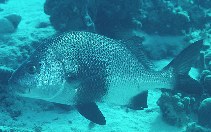
Espinas dorsales (total) : 12; Radios blandos dorsales (total) : 18; Espinas anales: 3; Radios blandos anales: 9. Front half of body darker than rear. Soft dorsal and anal fins have dense scales on bases of interradial membranes (Ref. 26938). Fins dusky, anal and pelvic fins darkest; peritoneum not black; young with two black stripes and a black spot at base of caudal fin (Ref. 13442).
Body shape (shape guide): short and / or deep.
Maximum depth from Ref. 126840. Inhabits larger patch reefs and quickly sloping rocky bottoms. Often near the shelter of caves, ledges, or wrecks (Ref. 9710). Feeds at night on crustaceans, mollusks, smaller fish, and the long-spined urchin, Diadema. Marketed fresh.
Life cycle and mating behavior
Madurez | Reproducción | Puesta | Huevos | Fecundidad | Larva
Distinct pairing during breeding (Ref. 205).
Robins, C.R. and G.C. Ray, 1986. A field guide to Atlantic coast fishes of North America. Houghton Mifflin Company, Boston, U.S.A. 354 p. (Ref. 7251)
IUCN Red List Status (Ref. 130435: Version 2025-1)
Threat to humans
Reports of ciguatera poisoning (Ref. 30303)
Human uses
Pesquerías: comercial; pesca deportiva: si; Acuario: Acuarios públicos
Herramientas
Special reports
Download XML
Fuentes de Internet
Estimates based on models
Preferred temperature (Referencia
123201): 24.2 - 26.1, mean 25.5 °C (based on 19 cells).
Phylogenetic diversity index (Referencia
82804): PD
50 = 0.5020 [Uniqueness, from 0.5 = low to 2.0 = high].
Bayesian length-weight: a=0.02042 (0.01215 - 0.03431), b=3.01 (2.86 - 3.16), in cm total length, based on LWR estimates for this species & (Sub)family-body (Ref.
93245).
Nivel trófico (Referencia
69278): 3.6 ±0.2 se; based on diet studies.
Resiliencia (Referencia
120179): Bajo, población duplicada en un tiempo mínimo de 4.5-14 años (Preliminary K or Fecundity.).
Fishing Vulnerability (Ref.
59153): Moderate to high vulnerability (50 of 100).
🛈
Nutrients (Ref.
124155): Calcium = 14.9 [7.1, 40.1] mg/100g; Iron = 0.467 [0.224, 0.919] mg/100g; Protein = 19.7 [17.8, 21.7] %; Omega3 = 0.127 [0.058, 0.254] g/100g; Selenium = 15.5 [6.5, 32.4] μg/100g; VitaminA = 26.1 [7.0, 98.0] μg/100g; Zinc = 0.585 [0.354, 0.950] mg/100g (wet weight);