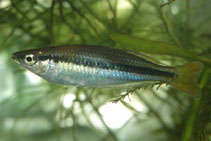
Melanotaenia nigrans, Blackbanded rainbowfish : fisheries, aquarium

You can sponsor this page

Melanotaenia nigrans (Richardson, 1843)

Blackbanded rainbowfish
Envoyez vos Photos et vidéos
Images | Stamps, coins, misc. | Images Google
Image of Melanotaenia nigrans (Blackbanded rainbowfish)
Melanotaenia nigrans
Photo de Baesler, S.

Classification / Names Noms communs | Synonymes | Catalog of Fishes(Genre, Espèce) | ITIS | CoL | WoRMS | Cloffa

> Atheriniformes (Silversides) > Melanotaeniidae (Rainbowfishes, blue eyes)
Etymology: Melanotaenia: Greek, melan, -anos = black + latin, taenia = stripe (Ref. 45335).
More on author: Richardson.

Environment: milieu / climate zone / profondeur / distribution range Écologie

; eau douce; saumâtre benthopélagique; pH range: 5.2 - 5.6; dH range: 10 - ?. Tropical; 18°C - 24°C (Ref. 2060)

Distribution Pays | Zones FAO | Écosystèmes | Occurrences | Carte par point | Introductions | Faunafri

Oceania: occurs only in Australia.

Taille / Poids / Âge

Maturité: Lm ?  range ? - ? cm
Max length : 10.0 cm TL mâle / non sexé; (Ref. 7020); common length : 6.0 cm SL mâle / non sexé; (Ref. 44894)

Biologie     Glossaire (ex. epibenthic)

Inhabits rainforest streams, lily lagoons and small streams. Also occurs in larger streams, usually in backwaters or along the shoreline where there is minimal flow and grassy vegetation. Often found in brackish coastal waters (Ref. 7020, 44894). Temperature and pH ranges are 23°-28°C and 5.5-7, respectively (Ref. 44894). Feeds mainly on aquatic and terrestrial insects and their larvae, and also filamentous green algae. Usually co-occurs with other species of rainbows and blue-blue eyes. A popular aquarium species which thrives in captivity. Type species (first species to be described) of the family Melanotaeniidae (Ref. 44894).

Life cycle and mating behavior Maturité | Reproduction | Frai | Œufs | Fécondité | Larves

Deposits thread-bearing eggs on plants. Distinct pairing (Ref. 205).

Référence principale Upload your references | Références | Coordinateur | Collaborateurs

Allen, G.R., 1989. Freshwater fishes of Australia. T.F.H. Publications, Inc., Neptune City, New Jersey. (Ref. 5259)

Statut dans la liste rouge de l'IUCN (Ref. 130435: Version 2025-1)

  Préoccupation mineure (LC) ; Date assessed: 15 February 2019

CITES

Not Evaluated

CMS (Ref. 116361)

Not Evaluated

Menace pour l'homme

  Harmless


Utilisations par l'homme

Pêcheries: commercial; Aquarium: Commercial
FAO - Publication: search | FishSource |

Plus d'informations

Écologie trophique
Food items (preys)
Composition du régime alimentaire
Consommation alimentaire
Food rations
Prédateurs
Écologie
Écologie
Home ranges
Population dynamics
Paramètres de croissance
Max. ages / sizes
Length-weight rel.
Length-length rel.
Fréquences de longueurs
Mass conversion
Recrutement
Abondance
Life cycle
Reproduction
Maturité
Maturity/Gills rel.
Fécondité
Frai
Spawning aggregations
Œufs
Développement de l'œuf
Larves
Dynamique des populations larvaires
Distribution
Pays
Zones FAO
Écosystèmes
Occurrences
Introductions
BRUVS - Videos
Anatomy
Surface branchiale
Brain
Otolith
Physiology
Body composition
Nutrients
Consommation d'oxygène
Type de nage
Vitesse de nage
Visual pigments
Fish sound
Diseases & Parasites
Toxicity (LC50s)
Génétique
génôme
Génétique
Heterozygosity
Héritabilité
Human related
Aquaculture systems
Profils d'aquaculture
Souches
Ciguatera cases
Stamps, coins, misc.
Outreach
Collaborateurs
Références
Références

Outils

Articles particuliers

Télécharger en XML

Sources Internet

AFORO (otoliths) | Alien/Invasive Species database | Aquatic Commons | BHL | Cloffa | Websites from users | FishWatcher | CISTI | Catalog of Fishes: Genre, Espèce | DiscoverLife | ECOTOX | FAO - Publication: search | Faunafri | Fishipedia | Fishtrace | GloBI | Google Books | Google Scholar | Google | IGFA World Record | OneZoom | Open Tree of Life | Otolith Atlas of Taiwan Fishes | PubMed | Reef Life Survey | Socotra Atlas | TreeBase | Arbre de Vie | Wikipedia: aller à, chercher | Zoological Record

Estimates based on models

Phylogenetic diversity index (Réf. 82804):  PD50 = 0.5000   [Uniqueness, from 0.5 = low to 2.0 = high].
Bayesian length-weight: a=0.01122 (0.00514 - 0.02450), b=3.04 (2.87 - 3.21), in cm total length, based on all LWR estimates for this body shape (Ref. 93245).
Niveau trophique (Réf. 69278):  2.9   ±0.35 se; based on food items.
Résilience (Réf. 120179):  Milieu, temps minimum de doublement de population : 1,4 à 4,4 années (Spawns throughout the year (Ref. 5259)).
Fishing Vulnerability (Ref. 59153):  Low vulnerability (10 of 100). 🛈
Catégorie de prix (Ref. 80766):   Unknown.