>
Eupercaria/misc (Various families in series Eupercaria) >
Haemulidae (Grunts) > Haemulinae
Etymology: Haemulon: Greek, haimaleos = bloody (Ref. 45335).
Eponymy: Franz Steindachner (1834–1919) was an Austrian zoologist who specialised in herpetology and ichthyology. [...] (Ref. 128868), visit book page.
More on authors: Jordan & Gilbert.
Environment: milieu / climate zone / profondeur / distribution range
Écologie
marin récifal; profondeur 0 - 50 m (Ref. 9626). Tropical; 25°N - 23°S
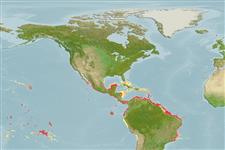
Western Atlantic: Panama to Santa Catarina, Brazil (Ref. 57756). Eastern Pacific: Mexico to Peru (Ref. 5530).
Taille / Poids / Âge
Maturité: Lm ? range ? - ? cm
Max length : 30.0 cm TL mâle / non sexé; (Ref. 7251); common length : 20.0 cm TL mâle / non sexé; (Ref. 3798); poids max. publié: 300.00 g (Ref. 5217)
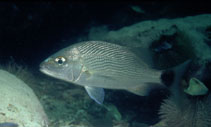
Épines dorsales (Total) : 12; Rayons mous dorsaux (Total) : 16; Épines anales: 3; Rayons mous anaux: 9. Body oblong, compressed and not very deep (depth contained 2.5 to 2.9 times in standard length); mouth large and terminal, its posterior end located at the same level as the posterior edge of the pupil; first gill arch with 19 to 25 gill rakers; dorsal fin notched, with 11 to 12 spines and 15 to 17 soft rays (XI-XII, 15-17); second anal spine slightly longer and stronger than third; scale series above lateral line oblique; body dark brown or silver gray; each scale bearing a pearly gray spot, the spots appearing to form lines following the scale series; lower part of preopercle with a black spot; caudal peduncle with a large dark spot; fins grayish (Ref. 55763). Scales below lateral line oblique; anal fin more heavily scaled than other species; silvery gray or brown on back, silvery on sides, with dark lines following oblique scale rows; a large black spot at caudal base (Ref. 13442).
Body shape (shape guide): fusiform / normal.
Found over sandy and rubble bottoms; occasionally on coral reefs and rocky areas (Ref. 3798). Rarely in clear oceanic insular areas (Ref. 5217). Often found in schools (Ref. 3798). Juveniles encountered near the shore, over sandy bottoms near seagrass beds (Ref. 9626). Feeds on benthic invertebrates (Ref. 3798). Marketed fresh (Ref. 3798).
Life cycle and mating behavior
Maturité | Reproduction | Frai | Œufs | Fécondité | Larves
Oviparous, distinct pairing during breeding (Ref. 205).
McKay, R.J. and M. Schneider, 1995. Haemulidae. Burros, corocoros, chulas, gallinazos, roncos. p. 1136-1173. In W. Fischer, F. Krupp, W. Schneider, C. Sommer, K.E. Carpenter and V. Niem (eds.) Guia FAO para Identification de Especies para lo Fines de la Pesca. Pacifico Centro-Oriental. 3 Vols. FAO, Rome. (Ref. 9114)
Statut dans la liste rouge de l'IUCN (Ref. 130435: Version 2025-1)
Menace pour l'homme
Harmless
Utilisations par l'homme
Pêcheries: intérêt commercial mineur; Aquarium: Aquariums publics; appât: usually
Outils
Articles particuliers
Télécharger en XML
Sources Internet
Estimates based on models
Preferred temperature (Réf.
123201): 23.8 - 28.1, mean 27.1 °C (based on 282 cells).
Phylogenetic diversity index (Réf.
82804): PD
50 = 0.5000 [Uniqueness, from 0.5 = low to 2.0 = high].
Bayesian length-weight: a=0.01349 (0.00851 - 0.02138), b=3.03 (2.90 - 3.16), in cm total length, based on LWR estimates for this species & Genus-body shape (Ref.
93245).
Niveau trophique (Réf.
69278): 3.7 ±0.2 se; based on diet studies.
Generation time: 3.7 ( na - na) years. Estimated as median ln(3)/K based on 1
growth studies.
Résilience (Réf.
120179): Milieu, temps minimum de doublement de population : 1,4 à 4,4 années (K=0.3;).
Fishing Vulnerability (Ref.
59153): Low to moderate vulnerability (34 of 100).
🛈
Nutrients (Ref.
124155): Calcium = 46.7 [16.0, 86.1] mg/100g; Iron = 0.58 [0.31, 1.03] mg/100g; Protein = 19.3 [17.4, 21.1] %; Omega3 = 0.145 [0.078, 0.231] g/100g; Selenium = 29.2 [17.4, 47.9] μg/100g; VitaminA = 101 [41, 245] μg/100g; Zinc = 1.2 [0.8, 1.8] mg/100g (wet weight);