>
Eupercaria/misc (Various families in series Eupercaria) >
Haemulidae (Grunts) > Haemulinae
Etymology: Orthopristis: Greek, ortho = straight + Greek, pristis = saw (Ref. 45335).
More on author: Cuvier.
Environment: milieu / climate zone / rango de profundidad / distribution range
Ecología
marino; salobre demersal; rango de profundidad 1 - 70 m (Ref. 9626). Tropical; 17°N - 29°S, 88°W - 34°W
Western Atlantic: Honduras to Brazil.
Length at first maturity / Tamaño / Peso / Age
Madurez: Lm 16.3 range ? - ? cm
Max length : 41.5 cm TL macho / no sexado; (Ref. 125970); common length : 30.0 cm TL macho / no sexado; (Ref. 3798); peso máximo publicado: 850.00 g (Ref. 9626)
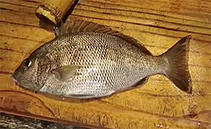
Espinas dorsales (total) : 12; Radios blandos dorsales (total) : 14; Espinas anales: 3; Radios blandos anales: 10. Mouth small and moderately oblique, the maxilla not reaching posterior to front edge of eye; grayish brown with violet hues on the back, silvery on the sides, with many small brown-orange spots on head, upper half of body and dorsal fin (Ref. 13442).
Body shape (shape guide): fusiform / normal.
Occurs in coastal waters, over sand, rock or mud bottoms (Ref. 13608). Juveniles found near the shore, associated with Thalassia beds (Ref. 9626). Also found in brackish water (Ref. 3798). Feeds on crustaceans, mollusks, polychaete worms, fishes, and other invertebrates (Ref. 9626). Well appreciated as a food fish; marketed fresh and salted (Ref. 5217).
Oviparous, distinct pairing during breeding (Ref. 205).
Courtenay, W.R. and H.F. Sahlman, 1978. Pomadasyidae. In W. Fischer (ed.) FAO species identification sheets for fishery purposes. Western Central Atlantic (Fishing Area 31), Volume 4. FAO, Rome. (Ref. 3798)
IUCN Red List Status (Ref. 130435: Version 2025-1)
Threat to humans
Harmless
Human uses
Pesquerías: comercial
Herramientas
Special reports
Download XML
Fuentes de Internet
Estimates based on models
Preferred temperature (Referencia
123201): 22.9 - 28, mean 25.7 °C (based on 530 cells).
Phylogenetic diversity index (Referencia
82804): PD
50 = 0.5156 [Uniqueness, from 0.5 = low to 2.0 = high].
Bayesian length-weight: a=0.01259 (0.01088 - 0.01457), b=2.97 (2.93 - 3.01), in cm total length, based on LWR estimates for this species (Ref.
93245).
Nivel trófico (Referencia
69278): 3.6 ±0.2 se; based on diet studies.
Generation time: 3.1 ( na - na) years. Estimated as median ln(3)/K based on 2
growth studies.
Resiliencia (Referencia
120179): Medio, población duplicada en un tiempo mínimo de 1.4-4.4 años (K=0.3).
Fishing Vulnerability (Ref.
59153): Low to moderate vulnerability (33 of 100).
🛈
Nutrients (Ref.
124155): Calcium = 138 [28, 266] mg/100g; Iron = 1.08 [0.57, 2.05] mg/100g; Protein = 18.8 [17.0, 20.6] %; Omega3 = 0.252 [0.130, 0.434] g/100g; Selenium = 49.8 [28.8, 90.9] μg/100g; VitaminA = 19.4 [9.1, 38.7] μg/100g; Zinc = 1.3 [0.9, 1.8] mg/100g (wet weight);