>
Eupercaria/misc (Various families in series Eupercaria) >
Sciaenidae (Drums or croakers)
Etymology: Cynoscion: Greek, kyon = dog + Greek, odous = teeth + Greek, skion, skiaina = barbel, red mullet (Ref. 45335).
Environment: milieu / climate zone / Tiefenbereich / distribution range
Ökologie
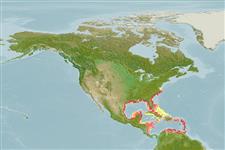
seewasser; brackwasser demersal; tiefenbereich 2 - 18 m (Ref. 1183). Subtropical; 39°N - 9°N, 98°W - 59°W
Western Atlantic: Maryland to northeastern Florida in the USA and throughout Gulf of Mexico. Reported from Campeche Bank in Mexico (Ref. 5733). Often misidentified as Cynoscion regalis (Ref. 3702).
Length at first maturity / Size / Gewicht / Alter
Geschlechtsreife: Lm 15.8, range 14 - 17 cm
Max length : 36.0 cm TL Männchen/unbestimmt; (Ref. 3702); common length : 25.0 cm TL Männchen/unbestimmt; (Ref. 3702); max. veröff. Alter: 1.20 Jahre (Ref. 31629)
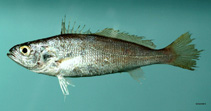
Rückenflossenstacheln (insgesamt) : 11; Rückenflossenweichstrahlen (insgesamt) : 26 - 31; Afterflossenstacheln: 2; Afterflossenweichstrahlen: 8 - 11; Wirbelzahl: 27. Colour greyish above and changing abruptly to silvery below. Back and upper sides sometimes with very faint irregular rows of spots. Dorsal fin dusky, other fins pale to yellowish. Mouth large, oblique, lower jaw projecting. Upper jaw with a pair of large canine-like teeth at tip. Lower jaw with a row of sharp enlarged inner-row teeth, widely spaced. Chin without barbels or pores. Snout with 2 marginal pores. Gas bladder with a pair of straight, horn-like anterior appendages. Soft portion of dorsal fin covered with small scales on basal half of in (Ref 51721).
Body shape (shape guide): fusiform / normal.
Occurs usually over sandy bottoms in inshore waters along beaches and in river mouths. Feeds mainly on crustaceans and fishes.
Robins, C.R. and G.C. Ray, 1986. A field guide to Atlantic coast fishes of North America. Houghton Mifflin Company, Boston, U.S.A. 354 p. (Ref. 7251)
IUCN Rote Liste Status (Ref. 130435: Version 2025-1)
Bedrohung für Menschen
Harmless
Nutzung durch Menschen
Fischereien: weniger kommerziell; Sportfisch: ja
Tools
Zusatzinformationen
Download XML
Internet Quellen
Estimates based on models
Preferred temperature (Ref.
123201): 23.4 - 28, mean 26.8 °C (based on 492 cells).
Phylogenetic diversity index (Ref.
82804): PD
50 = 0.5000 [Uniqueness, from 0.5 = low to 2.0 = high].
Bayesian length-weight: a=0.01230 (0.00776 - 0.01949), b=3.01 (2.88 - 3.14), in cm total length, based on LWR estimates for this species & Genus-body shape (Ref.
93245).
Trophic level (Ref.
69278): 4.0 ±0.60 se; based on food items.
Generation time: 5.0 ( na - na) years. Estimated as median ln(3)/K based on 1
growth studies.
Widerstandsfähigkeit (Ref.
120179): mittel, Verdopplung der Population dauert 1,4 - 4,4 Jahre. (K=0.22).
Fishing Vulnerability (Ref.
59153): Moderate vulnerability (38 of 100).
🛈
Nutrients (Ref.
124155): Calcium = 88.6 [49.6, 178.0] mg/100g; Iron = 0.932 [0.487, 1.800] mg/100g; Protein = 19 [18, 21] %; Omega3 = 0.33 [0.18, 0.55] g/100g; Selenium = 16 [8, 33] μg/100g; VitaminA = 17.9 [5.9, 62.9] μg/100g; Zinc = 0.905 [0.638, 1.335] mg/100g (wet weight); based on
nutrient studies.