>
Anguilliformes (Eels and morays) >
Anguillidae (Freshwater eels)
Etymology: Anguilla: Latin, anguilla, .-ae = eel (Ref. 45335).
Eponymy: Dr Johann Karl Ernst Dieffenbach (1811–1855) was a German physician, naturalist, explorer, linguist and writer. [...] (Ref. 128868), visit book page.
More on author: Gray.
Environment: milieu / climate zone / rango de profundidad / distribution range
Ecología
marino; agua dulce; salobre demersal; catadromo (Ref. 51243). Subtropical; 34°S - 47°S
Southwest Pacific: endemic to New Zealand.
Length at first maturity / Tamaño / Peso / Age
Madurez: Lm ?, range 80 - ? cm
Max length : 185 cm TL macho / no sexado; (Ref. 44724); 156.0 cm TL (female); common length : 60.0 cm TL macho / no sexado; (Ref. 9258); common length :100 cm TL (female); peso máximo publicado: 25.0 kg (Ref. 11115)
Short description
Claves de identificación | Morfología | Morfometría
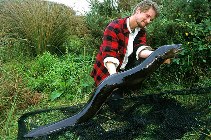
Commonly found in lakes and rivers (Ref. 9258). Inhabits stony rivers (Ref. 9072). Migrates to the sea to breed. Oviparous (Ref. 205). Marketed fresh, smoked and frozen; eaten fried and broiled (Ref. 9988). Reports of reaching up to 2 meters and 50 kilograms are rare and more common historically; in recent times, only a few exceed 120 cm TL (Ref. 82796).
Life cycle and mating behavior
Madurez | Reproducción | Puesta | Huevos | Fecundidad | Larva
Armitage, R.O., D.A. Payne, G.J. Lockley, H.M. Currie, R.L. Colban, B.G. Lamb and L.J. Paul (eds.), 1994. Guide book to New Zealand commercial fish species. Revised edition. New Zealand Fishing Industry Board, Wellington, New Zealand, 216 p. (Ref. 9258)
IUCN Red List Status (Ref. 130435: Version 2025-1)
Threat to humans
Harmless
Human uses
Pesquerías: comercial; Acuicultura: experimental
Herramientas
Special reports
Download XML
Fuentes de Internet
Estimates based on models
Preferred temperature (Referencia
123201): 10.6 - 18.3, mean 15.1 °C (based on 138 cells).
Phylogenetic diversity index (Referencia
82804): PD
50 = 0.5000 [Uniqueness, from 0.5 = low to 2.0 = high].
Bayesian length-weight: a=0.00093 (0.00076 - 0.00115), b=3.20 (3.15 - 3.25), in cm total length, based on LWR estimates for this species (Ref.
93245).
Nivel trófico (Referencia
69278): 4.5 ±0.5 se; based on diet studies.
Resiliencia (Referencia
120179): Muy bajo, población duplicada en un tiempo mínimo superior a 14 años (Tmax=60; tm=10-48 years based on age-length relationship.).
Fishing Vulnerability (Ref.
59153): Very high vulnerability (90 of 100).
🛈