Classification / Names
Noms communs | Synonymes | Catalog of Fishes(Genre, Espèce) | ITIS | CoL | WoRMS | Cloffa
>
Siluriformes (Catfishes) >
Doradidae (Thorny catfishes) > Doradinae
Etymology: Platydoras: Greek, platys = flat + Greek, doras = skin (Ref. 45335).
Eponymy: John Hancock (1808–1890) was a British naturalist, landscape architect, ornithologist and taxidermist. [...] (Ref. 128868), visit book page.
More on author: Valenciennes.
Environment: milieu / climate zone / profondeur / distribution range
Écologie
; eau douce démersal; pH range: 6.0 - 8.0; dH range: 5 - 19. Tropical; 23°C - 28°C (Ref. 1672)
South America: Guyana and eastern Brazil to Peru and Bolivia.
Taille / Poids / Âge
Maturité: Lm ? range ? - ? cm
Max length : 15.0 cm TL mâle / non sexé; (Ref. 1672)
Description synthétique
Clés d'identification | Morphologie | Morphométrie
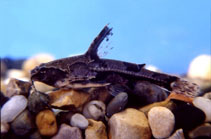
Épines dorsales (Total) : 1; Rayons mous dorsaux (Total) : 6; Rayons mous anaux: 11 - 13. The body is a little elongated, without scales but with a lateral range of 24 to 28 bony plaque. Head is large and rounded. Mouth is nearly terminal and has three pairs of barbels (Ref. 35381).
Body shape (shape guide): elongated.
Occurs in freshwater coastal swamps and the flood-prone zones of rivers. Gregarious, lives schools which may consist of several hundred fish. Hides under roots, leaves or stocks. Is known to build a nest of bubbles at the surface, defended by the males as the 'Atipas' do. In case of drought, it is reputed to being very resistant and to crawl in search of a new swamp while holding some water in its ears. Feeds on algae and debris (Ref. 35381).
Life cycle and mating behavior
Maturité | Reproduction | Frai | Œufs | Fécondité | Larves
Builds a bubble nest with small parts of water plants under the surface. The male guards the nest (Ref. 1672).
Piorski, N.M., J.C. Garavello, Arce H.M. and M.H. Sabaj Pérez, 2008. Platydoras brachylecis, a new species of thorny catfish (Siluriformes: Doradidae) from northeastern Brazil. Neotrop. Ichthyol. 6(3):481-494. (Ref. 79514)
Statut dans la liste rouge de l'IUCN (Ref. 130435: Version 2025-1)
Menace pour l'homme
Harmless
Utilisations par l'homme
Pêcheries: sans intérêt; Aquarium: Commercial
Outils
Articles particuliers
Télécharger en XML
Sources Internet
Estimates based on models
Phylogenetic diversity index (Réf.
82804): PD
50 = 0.5312 [Uniqueness, from 0.5 = low to 2.0 = high].
Bayesian length-weight: a=0.01122 (0.00528 - 0.02384), b=2.98 (2.80 - 3.16), in cm total length, based on LWR estimates for this (Sub)family-body shape (Ref.
93245).
Niveau trophique (Réf.
69278): 2.0 ±0.00 se; based on food items.
Résilience (Réf.
120179): Haut, temps minimum de doublement de population inférieur à 15 mois (Preliminary K or Fecundity.).
Fishing Vulnerability (Ref.
59153): Low vulnerability (10 of 100).
🛈