



Neolissochilus hexagonolepis (McClelland, 1839)
Copper mahseer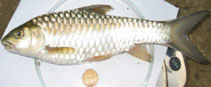
分類 / 名稱 俗名 | 同種異名 | Catalog of Fishes(屬, 種) | ITIS | CoL | WoRMS | Cloffa
Teleostei > Cypriniformes (Carps) 鯉形目 (Carps) > Cyprinidae (Minnows or carps) 鯉科 (Minnows or carps) > Torinae
Etymology: Neolissochilus: Greek, neos = new + Greek,lissos = smooth + Greek, cheilos = lip (Ref. 45335).
More on author: McClelland.
Etymology: Neolissochilus: Greek, neos = new + Greek,lissos = smooth + Greek, cheilos = lip (Ref. 45335).
More on author: McClelland.
Taxonomic Remarks
Genus Eschmeyer, pers. comm.
環境: 環境 / 氣候帶 / 深度上下限 / 配送範圍 生態學
; 淡水 底中水層性; 河川洄游 (Ref. 51243). 熱帶
分布 領土 | FAO區域 | 生態系 | 發現紀錄 | 分布圖 | 簡介 | Faunafri
Asia: India, Bangladesh, Nepal, Myanmar, Thailand, Malaysia, Indonesia and China. Also in Bhutan (Ref. 40882), Pakistan and Viet Nam (Ref. 3443).
亞洲: 印度,孟加拉,尼泊爾,緬甸,泰國,馬來西亞,印尼與中國。
亞洲: 印度,孟加拉,尼泊爾,緬甸,泰國,馬來西亞,印尼與中國。
初熟時的長度 / 大小 / 重量 / 年齡
Adults occur in fast flowing streams and rivers with rocky bottom (Ref. 41236), mainly in the middle of streams. Omnivorous. Adults feed mainly on filamentous green algae, lesser on chironomid larvae, crustaceans and water beetles (Ref. 40961). They migrate upstream during the breeding season where spawning takes place on stones and gravel (Ref. 41864). Spawning occur from April to October with a peak in August to September. Males mature at 9 cm. Flesh is considered delicious and market demand is great.
出現於快速地流動溪流與河川有岩石的底部.(參考文獻 41236) 主要生活在溪流中游中。 雜食性。 主要吃絲狀的綠藻,較少吃寶刀魚仔魚,甲殼動物與水蟲。 (參考文獻 40961) 在繁殖季節的時候向上游迴游在哪裡產卵在石頭與礫石上發生.(參考文獻 41864) 產卵從四月到十月在八月到九月具有一個高峰。 雄性在 9 公分時成熟。 肉一般認為可口的與市場要求是大的。
出現於快速地流動溪流與河川有岩石的底部.(參考文獻 41236) 主要生活在溪流中游中。 雜食性。 主要吃絲狀的綠藻,較少吃寶刀魚仔魚,甲殼動物與水蟲。 (參考文獻 40961) 在繁殖季節的時候向上游迴游在哪裡產卵在石頭與礫石上發生.(參考文獻 41864) 產卵從四月到十月在八月到九月具有一個高峰。 雄性在 9 公分時成熟。 肉一般認為可口的與市場要求是大的。
生命週期和交配行為 成熟度 | 繁殖 | 產卵場 | 卵 | 孕卵數 | 仔魚
亞洲: 印度,孟加拉,尼泊爾,緬甸,泰國,馬來西亞,印尼與中國。
主要參考資料
上傳您的推薦信 | 參考文獻 | 合作者 | 合作者
Talwar, P.K. and A.G. Jhingran, 1991. Inland fishes of India and adjacent countries. vol 1. A.A. Balkema, Rotterdam. i-liv + 1-541, 1 map (Ref. 4832)
CITES
Not Evaluated
對人類具威脅
無害處的
人類使用
漁業: 商業性; 養殖: 商業性; 游釣魚種: 是的
FAO - Publication: search | FishSource |
更多資訊
工具
特別的報告
下載 XML
網路資源
AFORO (otoliths) | Alien/Invasive Species database | Aquatic Commons | BHL | Cloffa | Websites from users | 檢查 FishWatcher | CISTI | Catalog of Fishes: 屬, 種 | DiscoverLife | ECOTOX | FAO - Publication: search | Faunafri | Fishipedia | Fishtrace | GloBI | Google Books | Google Scholar | Google | IGFA World Record | OneZoom | Open Tree of Life | Otolith Atlas of Taiwan Fishes | PubMed | Reef Life Survey | Socotra Atlas | TreeBase | 樹狀分類階層 | Wikipedia: 去, 搜尋 | World Records Freshwater Fishing | 動物學的記錄
基於模型的估計
系統發育多樣性指數 (參考文獻 82804): PD50 = 0.5000 [Uniqueness, from 0.5 = low to 2.0 = high].
Bayesian length-weight: a=0.00977 (0.00520 - 0.01838), b=3.02 (2.86 - 3.18), in cm total length, based on LWR estimates for this species & (Sub)family-body (Ref. 93245).
營養階層 (參考文獻 69278): 3.0 ±0.37 se; based on food items.
回復力 (參考文獻 120179): 中等的, 族群倍增時間最少 1.4 - 4.4年 (tm=3).
營養素 (Ref. 124155): Calcium = 221 [44, 1,161] mg/100g; Iron = 1.68 [0.63, 3.64] mg/100g; Protein = 18 [16, 20] %; Omega3 = 0.419 [0.187, 0.938] g/100g; Selenium = 96.4 [42.5, 194.0] μg/100g; VitaminA = 32.4 [14.7, 67.5] μg/100g; Zinc = 1.77 [0.90, 3.10] mg/100g (wet weight); based on nutrient studies.