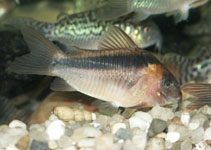
>
Siluriformes (Catfishes) >
Callichthyidae (Callichthyid armored catfishes) > Corydoradinae
Etymology: Corydoras: Greek, kory = helmet + greek, doras = skin (Ref. 45335).
Eponymy: Auguste Rabaut (1894–1985) was an explorer and natural history collector who lived and travelled in South America (1930s and 1940s) for the Smithsonian and for the AMNH. [...] (Ref. 128868), visit book page.
Environment: milieu / climate zone / rango de profundidad / distribution range
Ecología
; agua dulce demersal; pH range: 6.0 - 8.0; dH range: 2 - 25. Tropical; 23°C - 25°C (Ref. 12468)
South America: Upper Amazon, Solimões, and Negro River basins.
Tamaño / Peso / Age
Madurez: Lm ? range ? - ? cm
Max length : 5.0 cm SL macho / no sexado; (Ref. 37395)
Facultative air-breathing (Ref. 126274)
Life cycle and mating behavior
Madurez | Reproducción | Puesta | Huevos | Fecundidad | Larva
The female holds 2-4 eggs between her pelvic fins, where the male fertilizes them for about 30 seconds. Only then the female swims to a suitable spot, where she attaches the very sticky eggs. The pair repeats this process until about 100 eggs have been fertilized and attached (Ref. 1672).
Reis, R.E., 2003. Callichthyidae (Armored catfishes). p. 291-309. In R.E. Reis, S.O. Kullander and C.J. Ferraris, Jr. (eds.) Checklist of the Freshwater Fishes of South and Central America. Porto Alegre: EDIPUCRS, Brasil. (Ref. 37395)
IUCN Red List Status (Ref. 130435: Version 2025-1)
Threat to humans
Harmless
Human uses
Pesquerías: sin interés; Acuario: Comercial
Herramientas
Special reports
Download XML
Fuentes de Internet
Estimates based on models
Phylogenetic diversity index (Referencia
82804): PD
50 = 0.5000 [Uniqueness, from 0.5 = low to 2.0 = high].
Bayesian length-weight: a=0.02512 (0.00965 - 0.06539), b=3.00 (2.77 - 3.23), in cm total length, based on LWR estimates for this (Sub)family-body shape (Ref.
93245).
Nivel trófico (Referencia
69278): 3.0 ±0.35 se; based on food items.
Resiliencia (Referencia
120179): Medio, población duplicada en un tiempo mínimo de 1.4-4.4 años (Fecunditi is at least about a hundred eggs (Ref.
1672)).
Fishing Vulnerability (Ref.
59153): Low vulnerability (10 of 100).
🛈