>
Blenniiformes (Blennies) >
Dactyloscopidae (Sand stargazers)
Etymology: Gillellus: Theodore Nicolas Gill (1837-1914) researcher of abyssal fishes and systematics (Ref. 45335); healae: Named after Elizabeth Heal in partial recognition for her years of efficient and willing assistance to Dr. C.E. Dawson (Ref. 27742).
Eponymy: Elizabeth Heal was Dawson’s assistant. [...] (Ref. 128868), visit book page.
Environment: milieu / climate zone / تغييرات عمق / distribution range
بوم شناسي
دريايي نزديك كف زي; تغييرات عمق 21 - 73 m (Ref. 27742). Tropical; 33°N - 12°N
Western Atlantic: South Carolina and northeastern Gulf of Mexico to Florida Keys in USA, and also Aruba.
Size / Weight / سن
بلوغ: Lm ? range ? - ? cm
Max length : 7.5 cm TL جنس نر / بدون خواص جنسي; (Ref. 7251)
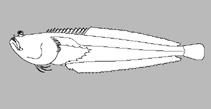
خارهاي باله پشتي (کل) : 11 - 15; شعاع نرم باله پشتي (کل) : 27 - 29; خارهاي باله مخرجي: 2. Common amongst Dactyloscopidae: Small, elongate fishes. Head usually broad and deep, body tapering and compressed behind. Eyes on top of head, often protrusible; mouth moderate to large, oblique to vertical; jaw teeth minute, in 2 or more series; no teeth on roof of mouth (vomer and palatines). Opercular opening large, gill membrane free from isthmus; opercles membranous, large, usually overlapping on underside of head, typically fringed above with 2 to 24 fleshy fimbriae. Dorsal fin continuous, with an isolated or semi-isolated anterior finlet, or with 1 to 5 separate anterior rays; dorsal-fin spines 7 to 23; anal-fin spines 2; dorsal and anal fins free or united to caudal fin by fragile membranes; pectoral fins broad-based, usually enlarged in mature males; caudal-fin rays simple or branched; pelvic fins under throat (insertion anterior to pectoral-fin base), with 1 spine and 3 thickened segmented rays; all other rays simple. Head and venter naked, body elsewhere with large cycloid scales (smooth to touch); lateral line high anteriorly, deflecting ventrally behind pectoral fin to continue along middle of side to caudal-fin base where terminal lateral-line scale bears ventrally directed canal. Body coloration, variably pale to strongly pigmented with white, brown, or reddish; some forms with characteristic saddle-like bars crossing back; others plain, mottled, or with indications of lateral stripes. Species distinguished by: dorsal-fin origin on nape; fin with an isolated or semi-isolated anterior finlet. Segmented caudal-fin rays usually 10; arched lateral-line scales 22 to 33. First preopercular canal not branched, with a single distal pore. Upper lip without fimbriae (Ref.52855).
Body shape (shape guide): elongated.
Burrows in soft sandy bottom, where it waits for prey, with only the eyes, nose and mouth protruding.
Life cycle and mating behavior
بلوغ | تولید مثل | تخم ریزی | تخم ها | Fecundity | توزاد ( لارو)
Robins, C.R., R.M. Bailey, C.E. Bond, J.R. Brooker, E.A. Lachner, R.N. Lea and W.B. Scott, 1991. Common and scientific names of fishes from the United States and Canada. Am. Fish. Soc. Spec. Publ. (20):183 p. (Ref. 3814)
وضعيت در فهرست قرمز IUCN (Ref. 130435: Version 2025-1)
خطر برای انسان ها
Harmless
استفاده انسانی
ابزارها
گزارش های ويژه
بارگيری XML
منابع اينترنتي
Estimates based on models
Preferred temperature (مرجع
123201): 22 - 27.6, mean 24.8 °C (based on 54 cells).
Phylogenetic diversity index (مرجع
82804): PD
50 = 0.5010 [Uniqueness, from 0.5 = low to 2.0 = high].
Bayesian length-weight: a=0.00389 (0.00180 - 0.00842), b=3.12 (2.94 - 3.30), in cm total length, based on all LWR estimates for this body shape (Ref.
93245).
Trophic level (مرجع
69278): 4.0 ±0.61 se; based on food items.
Fishing Vulnerability (Ref.
59153): Low vulnerability (10 of 100).
🛈