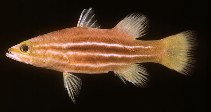
Liopropoma africanum, African basslet

You can sponsor this page

Liopropoma africanum (Smith, 1954)

African basslet
Add your observation in Fish Watcher
Native range | All suitable habitat | Point map | Year 2050
This map was computer-generated and has not yet been reviewed.
Liopropoma africanum   AquaMaps   Data sources: GBIF OBIS
Upload your photos and videos
Bilder | Google image
Image of Liopropoma africanum (African basslet)
Liopropoma africanum
Picture by Randall, J.E.

Classification / Names Populärnamn | synonymer | Catalog of Fishes(Släkte, Arter) | ITIS | CoL | WoRMS | Cloffa

> Perciformes/Serranoidei (Groupers) > Liopropomatidae (Painted basslets) > Liopropomatinae
Etymology: Liopropoma: Greek, leio = smooth + Greek, pro = in front of + Greek, poma, -atos = cover, operculum (Ref. 45335).
More on author: Smith.

Environment: milieu / climate zone / djupintervall / distribution range Ekologi

marina revassocierade; djupintervall 8 - 48 m (Ref. 9710). Tropical; 15°N - 15°S

Utbredning Länder | FAO områden | Ekosystem | Förekomster | Prickkarta | Utplanteringar | Faunafri

Indian Ocean: Pemba Island, Tanzania to Djibouti (Ref. 6180). Reported from West Sumatra, Indonesia (Ref. 31270).

Size / Vikt / Age

Könsmognad: Lm ?  range ? - ? cm
Max length : 8.0 cm TL hane/ej könsbestämd; (Ref. 9710)

Biologi     Ordlista (t.ex. epibenthic)

Inhabits recesses of seaward reefs (Ref. 9710).

Life cycle and mating behavior Könsmognad | Reproduktion | Lek | Ägg | Fecundity | Larver

Main reference Upload your references | referenser | Koordinator | Medarbetare

Randall, J.E. and L. Taylor, 1988. Review of the Indo-Pacific fishes of the serranid genus Liopropoma, with descriptions of seven new species. Indo-Pac. Fish. (16):47 p. (Ref. 6180)

IUCN Red List Status (Ref. 130435: Version 2025-1)

  Least Concern (LC) ; Date assessed: 19 July 2017

CITES

Not Evaluated

CMS (Ref. 116361)

Not Evaluated

Threat to humans

  Harmless


Human uses

FAO - Publication: search | FishSource |

Ytterligare information

Trophic ecology
Food items (preys)
Födosammansättning
Födointag
Food rations
Predatorer
Ekologi
Ekologi
Home ranges
Population dynamics
Tillväxtparametrar
Max. ages / sizes
Length-weight rel.
Length-length rel.
Length-frequencies
Mass conversion
Rekrytering
Abundans
Life cycle
Reproduktion
Könsmognad
Maturity/Gills rel.
Fecundity
Lek
Spawning aggregations
Ägg
Egg development
Larver
Larvdynamik
Utbredning
Länder
FAO områden
Ekosystem
Förekomster
Utplanteringar
BRUVS - Videos
Anatomy
Gälyta
Brain
Otolith
Physiology
Body composition
Nutrients
Syreförbrukning
Swimming type
Simhastighet
Visual pigments
Fish sound
Diseases & Parasites
Toxicity (LC50s)
Genetik
Genome
Genetik
Heterozygosity
Ärftlighet
Human related
Aquaculture systems
Vattenbruksprofiler
Avelslinjer
Ciguatera cases
Stamps, coins, misc.
Outreach
Medarbetare
referenser
referenser

Verktyg

Special reports

Download XML

Internet-källor

AFORO (otoliths) | Aquatic Commons | BHL | Cloffa | Websites from users | Check FishWatcher | CISTI | Catalog of Fishes: Släkte, Arter | DiscoverLife | ECOTOX | FAO - Publication: search | Faunafri | Fishipedia | Fishtrace | GloBI | Google Books | Google Scholar | Google | IGFA World Record | OneZoom | Open Tree of Life | Otolith Atlas of Taiwan Fishes | PubMed | Reef Life Survey | Socotra Atlas | TreeBase | Tree of Life | Wikipedia: Go, sök | Zoological Record

Estimates based on models

Preferred temperature (Ref. 123201): 26.8 - 29.2, mean 28.2 °C (based on 66 cells).
Phylogenetic diversity index (Ref. 82804):  PD50 = 0.5000   [Uniqueness, from 0.5 = low to 2.0 = high].
Bayesian length-weight: a=0.01122 (0.00514 - 0.02450), b=3.04 (2.87 - 3.21), in cm total length, based on all LWR estimates for this body shape (Ref. 93245).
Trofisk nivå (Ref. 69278):  3.6   ±0.6 se; based on size and trophs of closest relatives
Fishing Vulnerability (Ref. 59153):  Low vulnerability (10 of 100). 🛈
Nutrients (Ref. 124155):  Calcium = 131 [65, 271] mg/100g; Iron = 0.895 [0.451, 1.627] mg/100g; Protein = 18.3 [16.5, 20.2] %; Omega3 = 0.199 [0.114, 0.349] g/100g; Selenium = 27 [13, 54] μg/100g; VitaminA = 157 [47, 545] μg/100g; Zinc = 1.85 [1.19, 2.77] mg/100g (wet weight);