



Aggiungete la vostra osservazione in Fish Watcher
| Native range | All suitable habitat | Point map | Year 2050 |

|
| This map was computer-generated and has not yet been reviewed. |
| Iluocoetes fimbriatus AquaMaps Data sources: GBIF OBIS |
Carica il tuo foto e Video
Immagini | Google image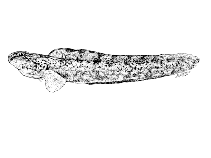 Iluocoetes fimbriatus
Immagine di Lloris, D.
Immagini | Google image
Immagine di Lloris, D.
Classificazione / Nomi Nomi Comuni | Sinonimi | Catalog of Fishes(Genere, Specie) | ITIS | CoL | WoRMS | Cloffa
> Perciformes/Zoarcoidei (Eelpouts and pricklebacks) > Zoarcidae (Eelpouts) > Lycodinae
Etymology: Iluocoetes: Greek, ilys, ilyos = mud + Greek, koites = hole, nest (Ref. 45335).
More on author: Jenyns.
Etymology: Iluocoetes: Greek, ilys, ilyos = mud + Greek, koites = hole, nest (Ref. 45335).
More on author: Jenyns.
Ambiente: milieu / zona climatica / distribuzione batimetrica / gamma di distribuzione Ecologia
marino; salmastro demersale; distribuzione batimetrica 0 - 600 m (Ref. 11954). Temperate; 37°S - 56°S
Distribuzione Territories | Aree FAO | Ecosistemi | Presenze | Mappa dei ritrovamenti | Introduzioni | Faunafri
Southeast Pacific and Southwest Atlantic: Chile and Argentina, including Tierra del Fuego (Ref. 27363).
Dimensione / Peso / Età
Breve descrizione Chiavi di identificazione | Morfologia | Morfometria
Spine dorsali (totale) : 0; Raggi dorsali molli (totale) : 85; Spine anali: 0; Raggi anali molli: 71; Vertebre: 83 - 97. This genus is distinguished by the following characters: presence of submental crests, not fused anteriorly; elongated and narrow neurocranium; the frontal bones are totally fused with no trace of a suture, the frontal corner squared; long frontal ramus; the sphenotic and parietal separated by pterotic; parietal bones meet in the mid-line; parasphenoid wing height high; juncture of ceratohyal-epihyal is smooth; branchiostegal rays 5; posterior hyomandibular ramus elongate; well developed palatal arch and posttemporal ventral ramus; scapular foramen enclosed by bone; with scapular strut; 4 notched radials (= actinosts); with postcleithrum; 85 dorsal fin-rays (last 7 counted from dorsal-fin pterygiophores); 71 anal-fin rays (last 10 counted from anal-fin pterygiophores); 18 pectoral fin rays; presence of pelvic bone; vertebrae asymmetrical (21+68=89); ribs on 4?21 abdominal vertebrae; 1 epural; dorsal-fin origin associated with vertebrae 4; well developed oral valve; gill slit extending ventrally to lower end of pectoral-fin base; blunt gill rakers; nub-like pyloric caeca; presence of scales, palatine and vomerine teeth; pale oral cavity; black peritoneum; a blurred brown band between the anteroventral edge of the eye and the upper jaw.
Additional diagnostic characters are the following: frontal and parasphenoid not separated by pterosphenoid; supraoccipital-exoccipìtal articulation excluded by epioccipitals; no supratemporal commissure and occipital pores; ascending rami of the parasphenoid reaches the upper margin of the trigeminofacialis foramen; well developed intercalar, not reaching prootic; 8-9 suborbital bones, canal with 7 pores; postorbital pores 1 and 4; single posterior nasal pore; cartilaginous basal plate of pectoral girdle with three foramina; vertebrae asymmetrical (19-21+ 64-77 = 83-97); dorsal-fin origin associated with vertebrae 2-4; well developed oral valve; blunt gill rakers; pelvic-fin rays ensheathed; squamation extensive, but head and pectoral-fin base and axil have no scales; lateral line mediolateral, palatine teeth 9-23; vomerine teeth 7-17 (Ref. 90127).
Body shape (shape guide): elongated; Cross section: oval.
Body shape (shape guide): elongated; Cross section: oval.
Found from the intertidal zone and brackish areas out to about 600 m (Ref. 11954).
Ciclo vitale e comportamento di accoppiamento Maturità | Riproduzione | Deposizione | Uova | Fecondità | Larve
Riferimento principale
Caricare le referenze | Bibliografia | Coordinatore | Collaboratori
Matallanas, J. and C. Corbella, 2012. Redescription of Iluocoetes Jenyns, 1842; proposal of a new genus, Argentinolycus, for Iluocoetes elongatus (Smitt, 1898), and description of Patagolycus melastomus gen. et sp. nov. (Teleostei, Zoarcidae). Zootaxa 3296:1-18. (Ref. 90127)
CITES
Not Evaluated
Minaccia per l'uomo
Harmless
Usi umani
Pesca: di nessun interesse
FAO - Publication: search | FishSource |
Informazioni ulteriori
Ecologia trofica
Articoli alimentari (prede)
Alimentazione
Consumo di cibo
Razioni alimentari
Predatori
Articoli alimentari (prede)
Alimentazione
Consumo di cibo
Razioni alimentari
Predatori
Dinamica della popolazione
Parametri di crescita
Età massima / dimensioni massime
Rapporto lunghezza-peso.
Lunghezza-lunghezza rel.
Lunghezza-frequenze
Conversione di massa
Reclutamento
Abbondanza
Parametri di crescita
Età massima / dimensioni massime
Rapporto lunghezza-peso.
Lunghezza-lunghezza rel.
Lunghezza-frequenze
Conversione di massa
Reclutamento
Abbondanza
Ciclo di vita
Riproduzione
Maturità
Maturità/Gli occhielli sono relativi.
Fecondità
Deposizione
Aggregazioni riproduttive
Uova
Sviluppo delle uova
Larve
Dinamica popolazioni larvali
Riproduzione
Maturità
Maturità/Gli occhielli sono relativi.
Fecondità
Deposizione
Aggregazioni riproduttive
Uova
Sviluppo delle uova
Larve
Dinamica popolazioni larvali
Anatomia
Area branchiale
Cervello
Otolite
Area branchiale
Cervello
Otolite
Fisiologia
Composizione corporea
Nutrienti
Consumo di ossigeno
Tipo di nuoto
Velocità di nuoto
Pigmenti visivi
Suono del pesce
Malattie e parassiti
Tossicità (LC50)
Composizione corporea
Nutrienti
Consumo di ossigeno
Tipo di nuoto
Velocità di nuoto
Pigmenti visivi
Suono del pesce
Malattie e parassiti
Tossicità (LC50)
Genetica
Genome
Genetica
Eterozigosi
Ereditarietà
Diversità genetica
Genome
Genetica
Eterozigosi
Ereditarietà
Diversità genetica
Legato all'uomo
Sistemi di acquacoltura
Profili di acquacoltura
Varietà
Casi di Ciguatera
Francobolli, monete, materiale vario.
Sistemi di acquacoltura
Profili di acquacoltura
Varietà
Casi di Ciguatera
Francobolli, monete, materiale vario.
Strumenti
Libro elettronico | Giuda pratica | Generatore frequenze di lunghezza | Strumento Parametri Biologici | Mappa dei ritrovamenti |
Cattura-MSY |
Rapporti speciali
Controllo della manutenzione dell'acquario | Verificare la presenza di schede informative sulle specie | Verifica delle schede informative sull'acquacoltura
Scarica XML
Fonti Internet
AFORO (otoliths) | Aquatic Commons | BHL | Cloffa | Websites from users | Check FishWatcher | CISTI | Catalog of Fishes: Genere, Specie | DiscoverLife | ECOTOX | FAO - Publication: search | Faunafri | Fishipedia | Fishtrace | GloBI | Google Books | Google Scholar | Google | IGFA World Record | Database Nazionali | OneZoom | Open Tree of Life | Otolith Atlas of Taiwan Fishes | PubMed | Reef Life Survey | Socotra Atlas | TreeBase | Tree of Life | Wikipedia: Go, ricerca | World Records Freshwater Fishing | Zoobank | Record zoologico
Stime basate su modelli
Temperatura preferita (Fonte Biblio. 123201): 4.5 - 9.7, mean 6.6 °C (based on 341 cells).
Indice di diversità filogenetica (Fonte Biblio. 82804): PD50 = 1.0000 [Uniqueness, from 0.5 = low to 2.0 = high].
Bayesian length-weight: a=0.00282 (0.00145 - 0.00550), b=3.20 (3.03 - 3.37), in cm total length, based on LWR estimates for this (Sub)family-body shape (Ref. 93245).
Livello trofico (Fonte Biblio. 69278): 3.4 ±0.4 se; based on size and trophs of closest relatives
Resilienza (Fonte Biblio. 120179): Basso, tempo minimo di raddoppiamento della popolazione 4.5 - 14 anni (Preliminary K or Fecundity.).
Nutrienti (Ref. 124155): Calcium = 39.7 [23.0, 72.1] mg/100g; Iron = 0.312 [0.185, 0.538] mg/100g; Protein = 16.4 [12.7, 19.8] %; Omega3 = 0.511 [0.291, 0.861] g/100g; Selenium = 17.7 [8.5, 41.5] μg/100g; VitaminA = 16.6 [5.7, 48.1] μg/100g; Zinc = 0.693 [0.499, 0.982] mg/100g (wet weight); based on nutrient studies.