Environment: milieu / climate zone / пределы глубины / distribution range
экология
морской ассоциированный с рифами; пределы глубины 0 - 64 m (Ref. 27370), usually 0 - 40 m (Ref. 37816). Tropical
Pacific Ocean: southern Japan to New Caledonia, Hawaii and Pitcairn.
Size / Вес / Возраст
половая зрелость: Lm ? range ? - ? cm
Max length : 23.0 cm SL самец/пол неопределен; (Ref. 27370); common length : 15.0 cm TL самец/пол неопределен; (Ref. 9137)
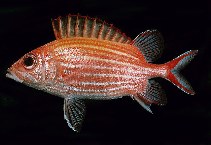
колючие лучи спинного плавника (общее число) : 11; членистые (мягкие) лучи спинного плавника (общее число) : 14; колючие лучи анального плавника: 4; членистые (мягкие) лучи анального плавника: 9 - 11. Body with alternate red and yellow stripes dorsally, and with red and silvery white on side; ventrally, the yellow stripes often as a series of close-set spots, one per scale; head red, an oblique silvery white streak below eye and a vertical one on edge of preopercle; spinous dorsal fin yellow with narrow red margin; white caudal fin with a submarginal red band in each lobe, converging and broadening basally. Five oblique rows of scales on cheek. Body depth 2.5-2.85 in SL; head length 2.6-2.95 in SL; snout length 3.4-3.9 in head length; interorbital width 5.3-6.0 in head length; slightly projecting lower jaw. Maxilla either extending slightly beyond a vertical at front edge of pupil or reaching below center of eye; upper jaw length 2.3-2.65 in head length; premaxillary groove extending to or slightly posterior to a vertical at anterior edge of orbit; anterior end of nasal bone rounded; medial margin of nasal bone without spinule; edge of nasal fossa with 1 to 7 spinules; upper edge of suborbital bones below anterior half of eye without a spine or serrae (below posterior half weakly serrated); preopercular spine about 2/3 times in orbit diameter, 4.3-5.3 in head length; 1st and 2nd dorsal spine subequal, usually the 3rd is the longest, 2.15-2.7 in head length; 3rd anal spine 1.55-1.75 in head length. Usually 10 anal soft rays (Ref. 27370).
Body shape (shape guide): fusiform / normal; Cross section: oval.
Inhabits deep reefs (Ref. 27370). Benthopelagic in or near crevices and caves (Ref. 58302). Feeds on small fishes and crustaceans (Ref. 89972).
Life cycle and mating behavior
половая зрелость | размножение | нерест | икра | Fecundity | личинки
Randall, J.E., 1998. Revision of the Indo-Pacific squirrelfishes (Beryciformes: Holocentridae: Holocentrinae) of the genus Sargocentron, with descriptions of four new species. Indo-Pac. Fish. (27):105 p. (Ref. 27370)
Статус Красного Списка МСОП (Ref. 130435: Version 2025-1)
Угроза для людей
Harmless
Использование человеком
рыболовство: коммерческий
дополнительная информация
инструменты
Специальные отчеты
Скачать в формате XML
ресурсы в Интернет
Estimates based on models
Preferred temperature (ссылка
123201): 24.4 - 29, mean 27.4 °C (based on 618 cells).
Phylogenetic diversity index (ссылка
82804): PD
50 = 0.5000 [Uniqueness, from 0.5 = low to 2.0 = high].
Bayesian length-weight: a=0.01660 (0.00788 - 0.03495), b=2.97 (2.80 - 3.14), in cm total length, based on LWR estimates for this Genus-body shape (Ref.
93245).
Trophic level (ссылка
69278): 4.0 ±0.67 se; based on food items.
устойчивость к внешним воздействиям (ссылка
120179): высокий, минимальное время удвоения популяции до 15 месяцев (Preliminary K or Fecundity.).
Fishing Vulnerability (Ref.
59153): Low vulnerability (18 of 100).
🛈
Nutrients (Ref.
124155): Calcium = 53.8 [20.8, 214.3] mg/100g; Iron = 0.49 [0.19, 1.48] mg/100g; Protein = 18.7 [17.5, 19.9] %; Omega3 = 0.163 [0.071, 0.372] g/100g; Selenium = 32.2 [18.8, 62.8] μg/100g; VitaminA = 89.4 [34.6, 246.8] μg/100g; Zinc = 1.67 [0.69, 3.14] mg/100g (wet weight);