This website uses cookies to enhance your browsing experience and ensure the functionality of our site. For more detailed information about the types of cookies we use and how we protect your privacy, please visit our Privacy Information page.
×
Cookie Settings
This website uses different types of cookies to enhance your experience. Please select your preferences below:
> Atheriniformes (Silversides) > Atherinidae (Silversides) > Atherinomorinae
Etymology: Atherinomorus:Greek, atherina, the Greek name for the eperlane + Greek, moros = silly, stupid (Ref. 45335). More on author: Forster.
Ambiente: milieu / zona climatica / distribuzione batimetrica / gamma di distribuzione Ecologia
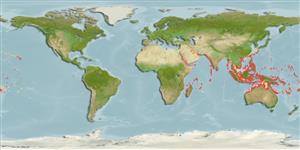
Indo-Pacific: from East Africa to Tonga, north to southern Japan, and south to northern
Australia; except Andaman Sea. Replaced by Atherinomorus insularum in the Hawaiian Islands (Ref. 37816).
Dimensione / Peso / Età
Maturità: Lm? range ? - ? cm Max length : 25.0 cm TL maschio/sesso non determinato; (Ref. 48635)
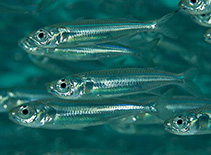
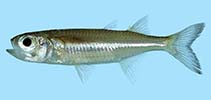
Spine dorsali (totale) : 5 - 8; Raggi dorsali molli (totale) : 9 - 10; Spine anali: 1; Raggi anali molli: 12 - 17; Vertebre: 43 - 44. This species is distinguished by the following characters: lateral process of premaxilla very low and wide; upper margin of the dentary almost flat distally, no distinct tubercle at the posterior end; posterior tip of the upper jaw reaching to or beyond a vertical through anterior margin of the pupil, sometimes reaching to the center of pupil; small teeth on endopterygoids, not forming obvious ridges; the anus is near or usually behind the posterior tip of the pelvic fin; lower gill rakers 18-24; midlateral scale count 40-44; lower margin of midlateral band reaching below ventral end of the midlateral (third) scale row and reaching to almost the center of the fourth scale row at level of the anal fin origin (Ref. 58474). Body shape (shape guide): elongated; Cross section: oval.
Common in large schools along sandy shorelines and reef margins. Reported to be mainly a nocturnal species which usually forms schools (from several hundred to more than 100 m long and 20 m wide) (Ref. 9760). Feeds mostly at night when the school disperse. Feeds on a variety of planktonic crustaceans. Preyed upon by sharks, tunas, long toms, and amberjacks which swim alongside the school. Among its other predators are crested terns, gannets, sea-gulls and herons. Slow moving and not well regarded as bait. Extremely important as forage fish for larger species (Ref. 3302). Sold fresh, or salted and dried (Ref. 12484). Minimum depth reported taken from Ref. 57178.
Ciclo vitale e comportamento di accoppiamento Maturità | Riproduzione | Deposizione | Uova | Fecondità | Larve
Kimura, S., D. Golani, Y. Iwatsuki, M. Tabuchi and T. Yoshino, 2007. Redescriptions of the Indo-Pacific atherinid fishes Atherinomorus forskalii, Atherinomorus lacunosus, and Atherinomorus pinguis. Ichthyol. Res. 54(2):145-159. (Ref. 58474)
Stato della Lista Rossa IUCN (Ref. 130435: Version 2025-2 (Global))
Ciclo di vita Riproduzione Maturità Maturità/Gli occhielli sono relativi. Fecondità Deposizione Aggregazioni riproduttive Uova Sviluppo delle uova Larve Dinamica popolazioni larvali
Fisiologia Composizione corporea Nutrienti Consumo di ossigeno Tipo di nuoto Velocità di nuoto Pigmenti visivi Suono del pesce Malattie e parassiti Tossicità (LC50)
Temperatura preferita (Fonte Biblio. 123201): 24.9 - 29.1, mean 28 °C (based on 1080 cells).
Indice di diversità filogenetica (Fonte Biblio. 82804): PD50 = 0.5020 [Uniqueness, from 0.5 = low to 2.0 = high].
Bayesian length-weight: a=0.00692 (0.00378 - 0.01267), b=3.17 (3.01 - 3.33), in cm total length, based on LWR estimates for this species & (Sub)family-body (Ref. 93245).
Livello trofico (Fonte Biblio. 69278): 3.3 ±0.2 se; based on diet studies.
Resilienza (Fonte Biblio. 120179): Medio, tempo minimo di raddoppiamento della popolazione 1.4 - 4.4 anni (Preliminary K or Fecundity.).
Vulnerabilità della pesca (Ref. 59153): Low vulnerability (15 of 100). 🛈